Features of fluorescent lamps for plants
For the full growth of seedlings and flowers, a sufficient amount of light is required. With a lack of natural light, you can use a fluorescent lamp for plants. Its characteristics affect growth and yield, so the choice of model matters.
Except fluorescent lamps use LED, gas discharge and incandescent lamps. Let's talk about the features of each of the devices.
Why do plants need a lamp?
Daylight is required by greenery for photosynthesis and development. The radiation range serves to produce chlorophyll, that is, green muscle mass. If there is not enough light, the sprouts will begin to reach up to capture as much of the sun's rays as possible. At the same time, plants spend all their energy on growth, exhausting the stems and are not able to grow dense enough foliage.
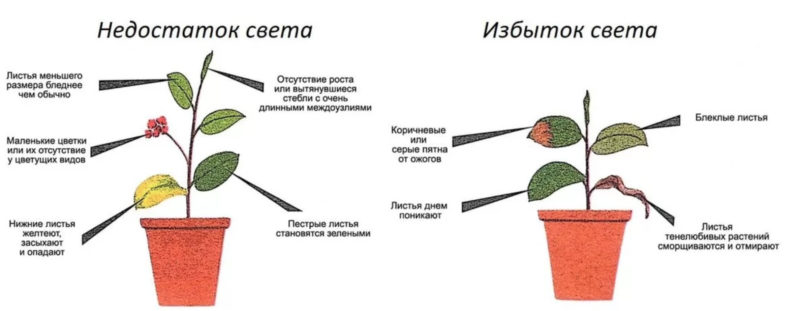
This blocks flowering, as the flower does not have enough strength.To compensate for the lack of daylight, special fluorescent lamps are installed for ornamental plants. The same cultivation technology should be used when planting seedlings in black soil. This is done in early spring, when daylight hours do not exceed 4 hours. For indoor plants, it is recommended to use additional lighting constantly.
Which plant lamp to choose
The type of fluorescent lamp is chosen taking into account the characteristics of the culture:
- photophilous. They belong to the cultures of northern growth. For normal development, you need to turn on the backlight for at least 15 hours a day. This means that the lamp must have a long life span of at least 20,000 hours;
- shade-loving. Require backlight 6-8 hours a day. A model with a resource of 6000-7500 hours is suitable;
- medium lighting, up to 8-10 hours a day. Need lamps with a lifespan of up to 10,000 hours.
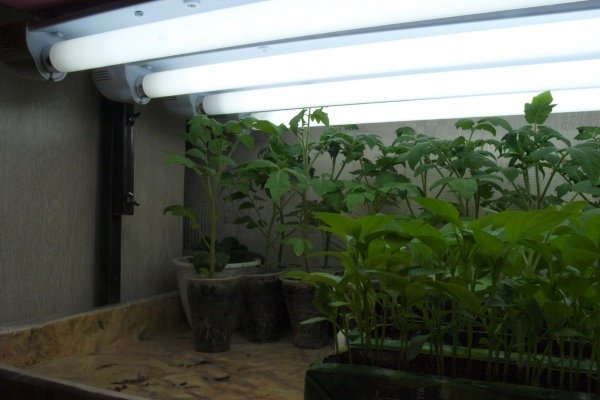
Speaking about the characteristics of light bulbs, pay attention to:
- plinth parameters. Use pin cartridges and threaded E14 and E27.
- power. Depends on the size of the bulb. For example, with a lamp length of 0.5 m, the power will be 18 W, and with 1.5 m - 58 W. The rated power does not affect the radiation intensity;
- moisture protection. If a fluorescent lamp is installed in a greenhouse or aquarium, it must have polymer protection against moisture;
- voltage. Usually this is the standard 220 volts.
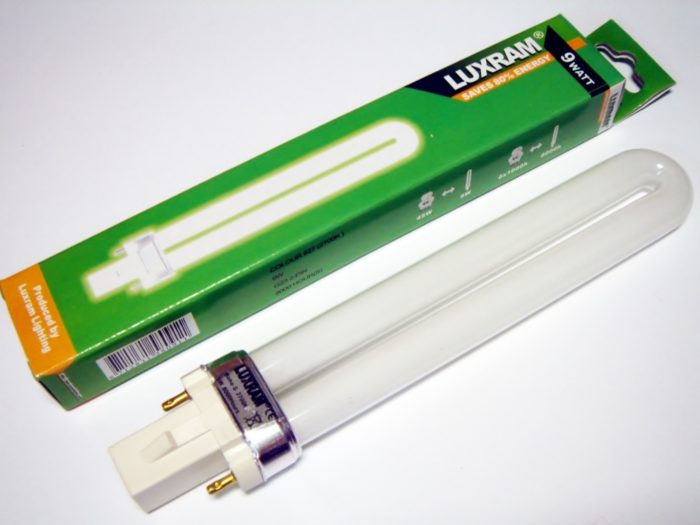
The lamps are different sizes. Compact can be installed in standard fixtures. The plant may need daylight, cool or red.
Linear are tubular products with a length of up to 1.5 m. They are fixed over seedlings in greenhouses on cables, racks and shelves.Modern devices are economical and give intense light.
Overview of popular models
Popular fluorescent lamps for plants:
| Model | The size (mm.) | Luminous flux (Lm) | Application | Prices |
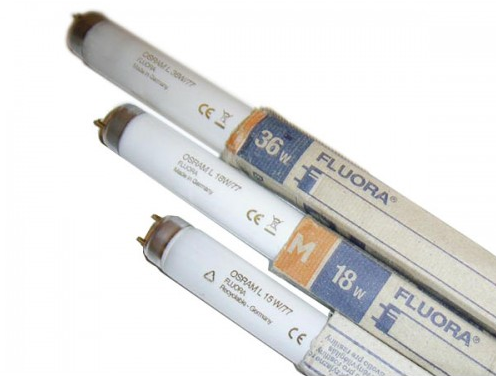
| Fluora L15W | 450 | 400 | Used at home and for seedlings and installation in an aquarium as additional lighting with a reduced light day. | 570 |
| Osram L58W | 1490 | 2255 | Installed in large greenhouses and nurseries. One of the best options for crops during fruiting and flowering. Used as the only source of illumination. | 950 |
| Fluora L30W | 895 | 1000 | They are mounted in greenhouses, on racks and window sills for plants that need to gain green mass, as well as during the flowering period as additional lighting. | 675 |
| Osram L36W | 1200 | 1400 | For medium greenhouses, nurseries and flowering plants as the sole source of light. | 720 |
| Fluora L18W | 590 | 550 | In houses for growing plants and newly planted seedlings. With a short light day, it can be installed as additional lighting. | 610 |
How to calculate the amount of light
Experienced gardeners recommend calculating the radiation intensity, starting from an area of 10 x 10 cm. To illuminate an area of 1 dm2 required:
- light-loving in the absence of natural light more than 2.5 watts;
- medium intensity - from 1.5 to 2 watts;
- heat-loving crops with insufficient natural light - 0.5-1.5 watts.
Lighting Installation Tips
Before installing the lamp, you must learn how to correctly determine the spectrum. For example, red and orange colors stimulate photosynthesis and energy production in plants, but are negative for flowering. A range from lilac to green is suitable here. Yellow remains neutral.
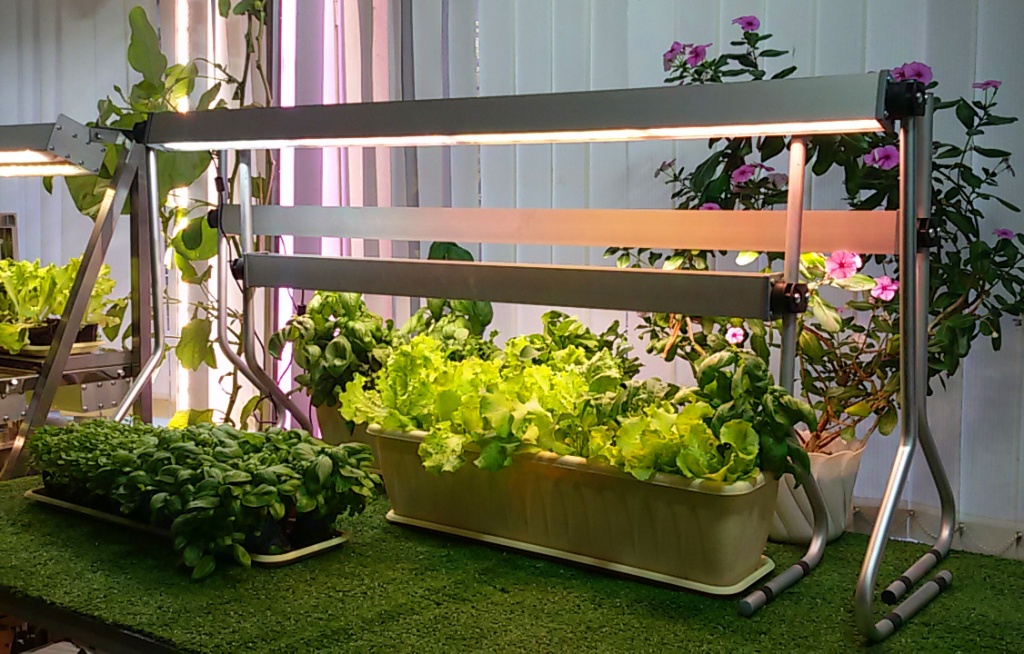
If shade-loving plants are grown, the lamp should be mounted at a distance of no more than 50 cm, light-loving - no more than 15 cm. It is recommended to install pots at the same height with each other. Flowers that love light more than others are best placed in the center, the rest at the edges. Fasteners for the lamp should move around the perimeter of the room.
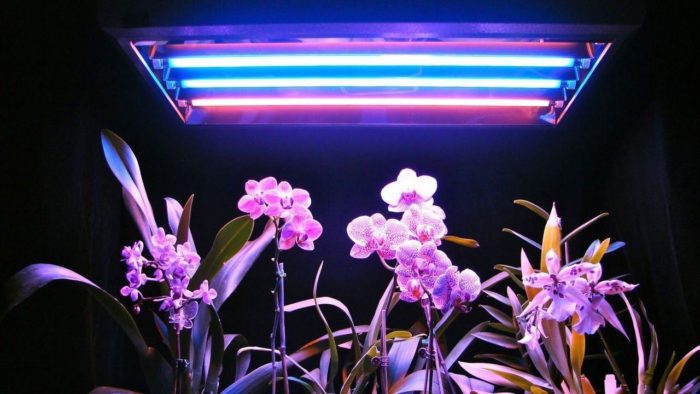
It is best to turn on the lights in the evening or at night, and turn off during the day, when there is enough natural light. A reflector should be installed on top and side of the lamp to reflect light to distant areas. Porcelain enamel, mirror or foil film are used as reflectors. The surface must be wiped with a clean cloth.
Rules for using the lamp
Yellow slows down the growth of the stem, so the peak of the spectrum is suitable for stem and aquarium plants, such as dracaena and ficus. To enhance the effect, you can install the lamp closer to the flowers, but not too much. In winter, the lighting time can be increased by 2-3 hours.
Turn on fluorescent lamp too often it is not worth it, it negatively affects the service life. Devices can be mounted if there are no voltage drops in the network.
Thematic video: Comparison of fluorescent and LED lamps for seedling illumination
Since there is mercury vapor inside the fluorescent lamp, it is recommended to install it in a safe place away from children. If the lighting is transported to another place, take care of a stable position to avoid mechanical damage. When replacing a light bulb, you can only take it with gloves. If greasy traces remain on it, when heated, this can provoke an explosion.
Advantages and disadvantages of using
The main advantage of fluorescent lamps is that they do not shine with a hot stream, so the flowers do not get burned. There are other advantages:
- duration of service life;
- high color rendering;
- profitability;
- optimal spectrum for plant growth;
- affordable prices.
Flaws:
- difficulty in connecting;
- in case of failure require special disposal;
- the high cost of quality models;
- there are harmful substances inside the lamp;
- over time, the quality of light transmission decreases.

Conclusion
Another advantage of a fluorescent lamp is that it can be used by experienced growers and beginners, it is enough to study the installation features and operating rules. At low prices, the devices cope with the load and last a long time.