How to install LED strip on the ceiling
LED ceiling lighting is used more and more often in rooms, as it provides not only a decorative effect, but can also serve as the main lighting. The main advantage is that anyone can put the tape if they follow the instructions and select high-quality elements for the system.
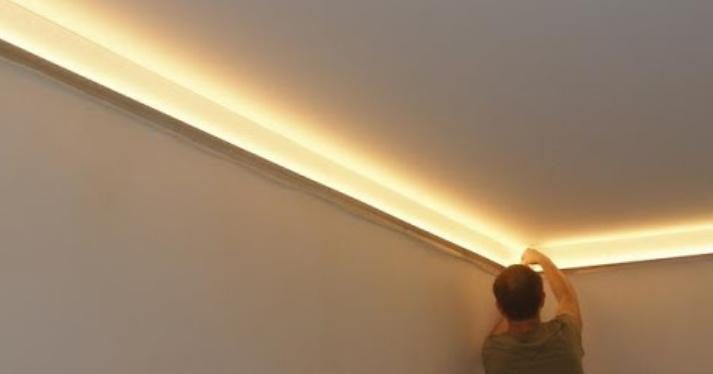
Pros and cons of the solution
First of all, you need to understand the advantages and disadvantages of this option in order to understand whether it is suitable. In most cases, there is simply no alternative, since the LED strip is much cheaper than analogues with similar properties and can be bought at almost every electrical store. The main advantages are:
- System security. The most common operating voltage is 12 V, rarely 24 V.Both the one and the other option do not pose a danger to life, and in case of electric shock, human health will not suffer.
- Versatility. You can put the tape both in living quarters and in bathrooms, toilets, kitchens and even on the street. For places with high humidity, it is worth choosing waterproof products, they are much more expensive.
- Compactness. The tape takes up little space - a maximum of a couple of centimeters in width and literally 5-10 mm in height. This allows you to place it in any niches, cavities or on the ceiling.
- Flexibility. The base bends well, so when attaching to corners, uneven or oval surfaces, there will be no problems. You just need to remove the protective layer and stick the tape to the base.
- Length adjustable. Places for cutting are usually located after 5 cm, but there are types that can be cut after 1-3 cm. It is not difficult to choose the exact length, you can cut as much as you need. But options with a voltage of 24 V are cut after 5-10 cm, this is worth remembering.
- Easy installation. Following the instructions and having a simple set of tools at hand, you can put the tape on your own.
- Low power consumption, this is one of the most economical options, so lighting costs will decrease.
- Long service life. A regular tape of good quality works for at least 10 years, which is much longer than any analogue.
- During operation, the LEDs heat up slightly, there is no need to make a system for dissipating heat.
- You can control both the switch and the remote control or the application from your smartphone.
- Lots of choices, both single and multi-color options.
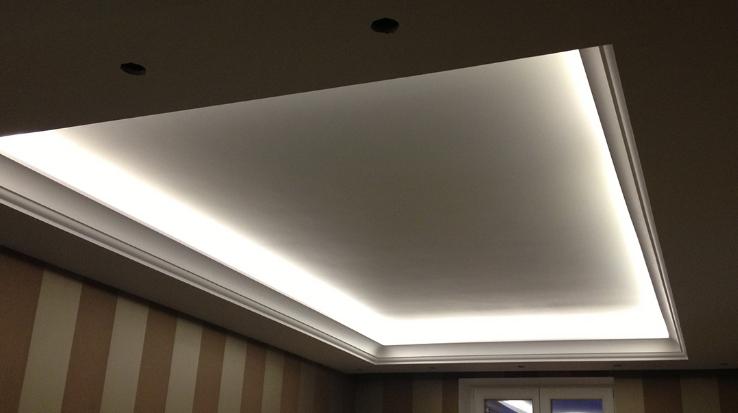
Note! When burning, no harmful substances are released.Even if the tape is damaged, nothing terrible will happen, there are no mercury vapors or glass elements in it.
The LED strip also has disadvantages, but they are much less than the advantages:
- For multi-color options, you need to use a controller, which costs a lot and fails faster than the ribbon itself.
- With a length of 3 meters or more, the end does not glow as brightly as the beginning due to current loss. The problem can be solved by bringing the wire to both sides, but this complicates and increases the cost of the project.
- The maximum length of one piece at a voltage of 12 V is 5 m, at 24 V it is 10 m. But several sections can be connected in parallel.
Tape ceiling lighting is easy to make, but the room will be transformed. And due to the controller, you can change the brightness and shades.
The choice of LED strip for different rooms
When buying a tape, you need to understand where it will be used and for what purposes. Only in this case, you can choose a specific option. You should not use the same product everywhere, consider the features of the room and the nature of the backlight.
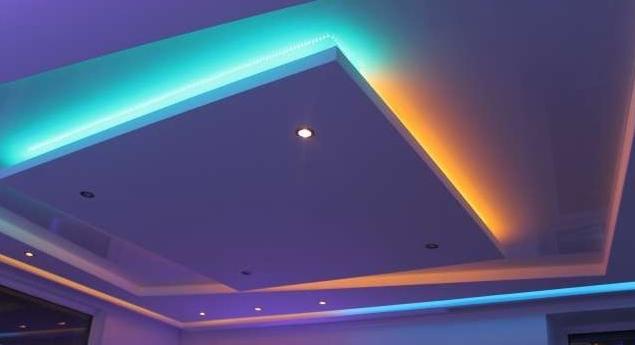
Before buying, you need to measure the approximate length of the tape in order to choose the right size roll. But first of all, it is worth considering the installation location. Use the guidelines in the next section.
What criteria to pay attention to, which is better
Considering the features for each room, you can decide what is best suited:
- In the bathroom, use only waterproof models. You can highlight niches, a place in front of a mirror or a perimeter, or you can make the tape the main lighting.
- In the bathroom, due to the small area, you can fix the monochrome version around the perimeter and provide good light.
- In the kitchen, the scope is very wide.You can highlight the work area, shelves in cabinets. Niches are often made or lighting is laid around the perimeter.
![General lighting in the kitchen.]() General lighting in the kitchen.
General lighting in the kitchen. - In a nursery, LEDs can serve as a night light at a minimum brightness. You can also illuminate the play area.
- For corridors, it is better to choose monophonic options, pay attention to brightness indicators, so that the light is of high quality.
- In the bedroom, you can make both decorative and basic lighting. The choice of type and characteristics depends on this. The light must be dimmed.
- In the living room, it is better to use powerful plain strips for general lighting or RGB options for decorative lighting. You can illuminate individual zones or niches.
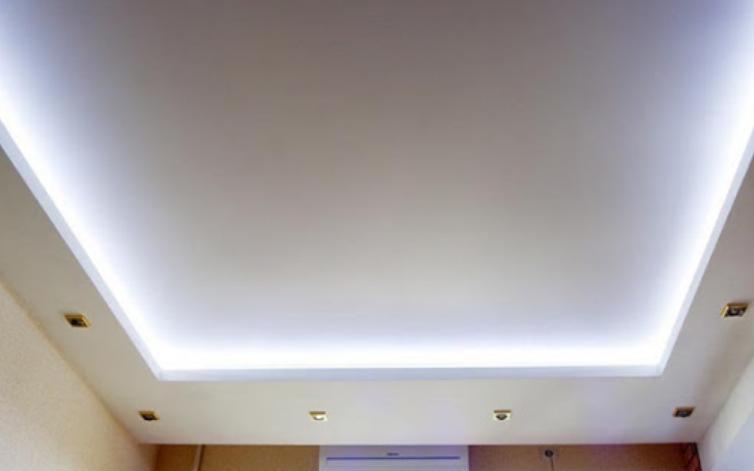
Important! Use lighting standards when choosing LED strip for different rooms.
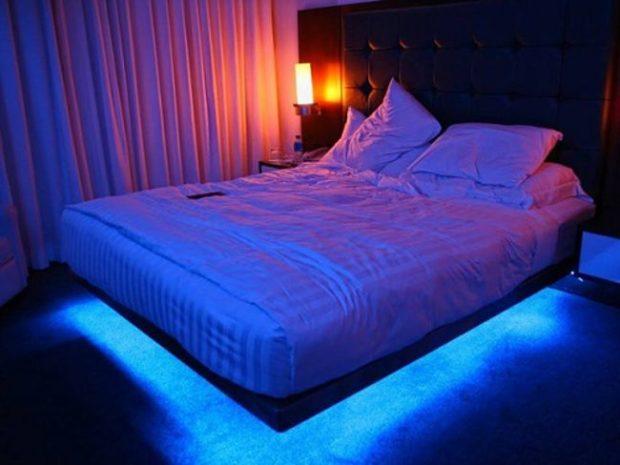
The best LED strip for lighting the ceiling
There are many options on the market, so it can be difficult to choose. First you need to deal with the brightness in order to understand how much power is required. It depends on the number of LEDs per meter and their size. As for the varieties, it is best to use the following options:
- Solid color, best for general lighting or white illumination of niches and cornices. It burns brightly, the light quality is good.
- RGB strip - a combination of three colors of LEDs: red, green and blue. By changing their brightness and intensity, you can achieve different shades and even make white light. But in terms of quality, it will be an order of magnitude worse than that of a single-color version.
- RGBW consists not only of colored diodes, there is a white one that burns with a bright cold light (approximately 6000 K).It can be used for both backlighting and lighting, but due to the high brightness, it is not suitable for everyone.
- RGBWW - a solution in which another white LED with warm light (2400-2700 K) is added. It can be used as a backlight and as a main light, because the brightness can be adjusted as you like.
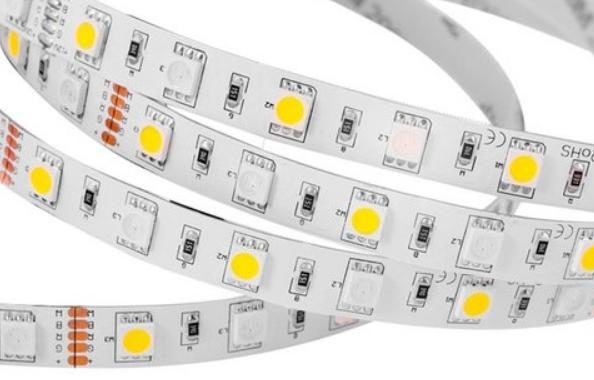
If you need to combine the main light and decorative lighting, you can lay two ribbons side by side. But this option will cost more than combined tapes with high-quality white light.
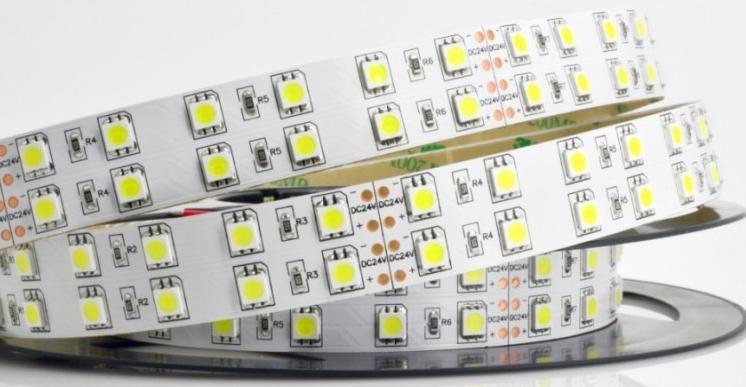
Which installation option to choose, the main varieties
LED strip on the ceiling can be mounted in different ways. Therefore, it is necessary to decide in advance how best to put it. It is necessary to prepare the base in advance, and sometimes make special designs even at the stage of ceiling repair. There are several main ways:
- The location of the lighting in niches along the perimeter of the ceiling or along the eaves. In this case, when installing a drywall structure, a gap is left in which the LED strip is placed.
- Protrusions in multi-level ceiling structures. In this case, when constructing frames or stretching the canvas, small shelves are left in which the tape is located with the LEDs up and illuminates the surface.
![How to install LED strip on the ceiling]() The option with a ledge around the perimeter looks impressive.
The option with a ledge around the perimeter looks impressive. - Using an aluminum profile specially adapted for the LED strip. The advantage of this option is that it is easy to mount, the appearance of the structure is neat, and the LEDs are covered with a diffuser, so the light is uniform.
- Ceiling trim around the perimeter. The simplest and yet looks good.
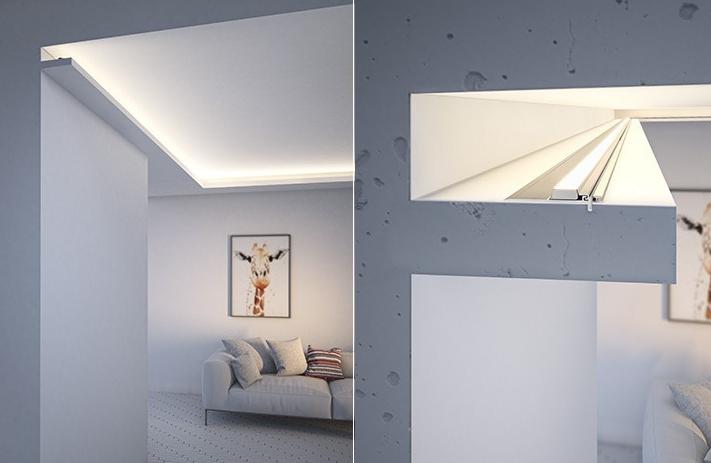
After choosing a method, it will become clear what to purchase and how to properly organize the work.
DIY LED lighting installation description
To do the job correctly, you need to follow the step-by-step instructions. However, it is not difficult, but requires accuracy and precision. The tape, with all its advantages, is easy to damage, especially if it is attached carelessly.
Preparation, necessary materials
First of all, you need to purchase an LED strip of the selected type. Always make a margin of 10-15% so that it doesn’t turn out that 5-10 cm is missing. Everything you need is also prepared:
- Controller for multicolor options. Select according to the total power of the LEDs and the type of tape. If the length is large, it is worth using several controllers to distribute the load.
- Dimmer to adjust brightness and hue. Set as desired.
- Copper wires for connection. Heat shrink tubing for insulating connections.
- Aluminum profile, if it will be used for lighting strips.
- Small soldering iron for connecting contacts. Sometimes you just need connectors.
- Construction knife, scissors of medium or large size.
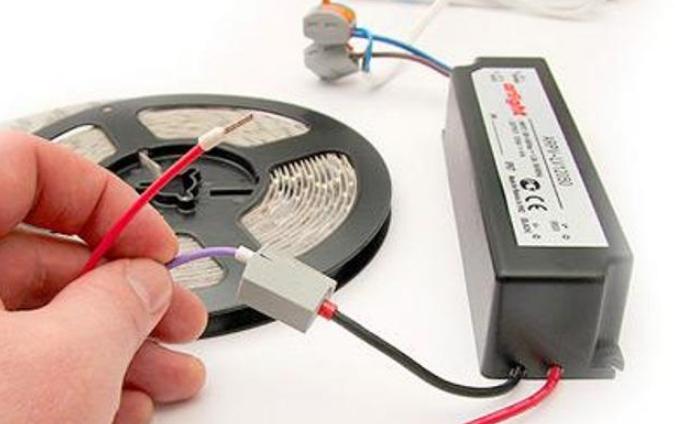
It is important to prepare a place for installation, it all depends on the features of the installation. If the tape will stick, then the surfaces must be leveled and cleaned of dust and dirt. You can degrease the base by wiping it with a cloth soaked in solvent. This will ensure good adhesion of the double-sided tape.
Note! If the surface is porous, it is advisable to prime it to strengthen the structure.
Wiring diagram
Before work, you need to draw at least the simplest diagram on which to indicate all the important points:
- The point of connection of the cable that supplies electricity.
- Location of the power supply unit or units and controllers. They should be easily accessible so that they can be checked or replaced if necessary.
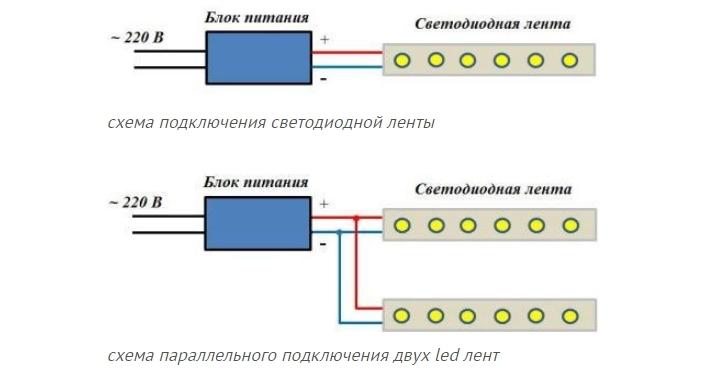
- The length of the tapes depends on the power of the equipment and the number of controllers, as well as the way they are connected.
- If you need to install two power supplies, connect them in parallel. When two tapes are placed on one block, then connect them as shown in the diagram below.
Mounting and power connection
If the preparation is carried out correctly, then installing the LED strip is easy. The process consists of several stages:
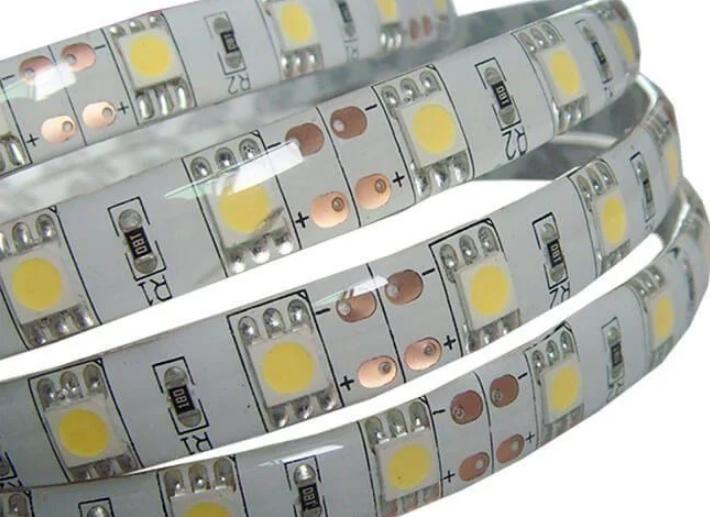
- Take measurements and cut off a piece of the desired length, if required. Cut only along dotted lines that have contacts. Connect the wires with a connector or by soldering them.
- If you need to connect two tapes, you can solder them directly on the contacts, the thickness of the base allows you to do this. Or use small pieces of wire.
- Connect the power supply and controller following the diagram. The main thing is not to confuse the conclusions so as not to disable the equipment. Check your work first.
- Fasten tape, for this it must be carefully glued along the line, gradually removing the protective layer from the back side. Place in the cavities or glue the power supply and controller with double-sided tape.
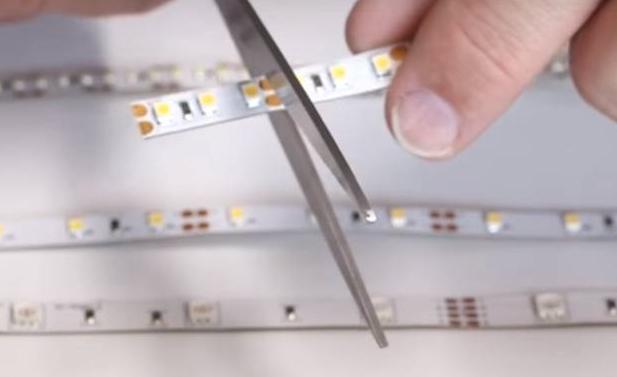
Important! The main thing is not to confuse the wires, because then you will have to redo the work. The tape will not burn out because of this.
Related video:
Common mistakes during installation
There are several mistakes that are often made during installation and due to which the LED strip lasts much less.Remember a few tips:
- Do not fix the backlight with plastic clamps. They pinch the base and it burns out in these places.
- Do not connect tapes in series with a total length of more than 5 m.
- When using the option in a silicone coating, it is better to glue it on an aluminum profile, which serves as a cooling radiator and prevents overheating.
- Choose a power supply with a power reserve of at least 30%. If he constantly works at the limit, he will not last long.
If you understand the topic, then choosing an LED strip and installing it on the ceiling is easy. The main thing is to choose a suitable power supply and controller, do not confuse the wires when connecting, and securely fix the backlight on the surface.