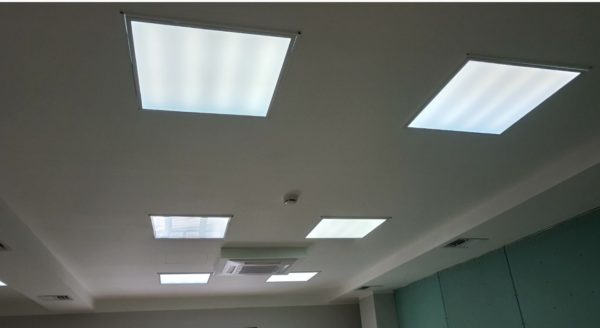
Installation of LED panels
Replacing incandescent lamps with diode light sources is a matter of time. Modern renovations increasingly include the installation of LED panels. These are devices for lighting large areas, such as shops, train stations, entertainment complexes, as well as apartments and houses. The main advantage is low energy consumption.
When compared with other light sources, the panels have a large luminous flux, while having a similar power. Also, the lifespan is important for the buyer. Diode devices last at least 10 times longer than other fixtures.
What you need to know when installing LED panels
The design of the product is usually as follows: the body is made of aluminum with improved thermal conductivity to remove heat from the LED elements. If the chips overheat, this will negatively affect the service life.
The internal diffuser is made of organic glass.It provides soft light spreading over the entire panel. Another design element is a light-conducting lens that creates a matte dispersion. Due to it, looking at the light, the eyes do not get tired, and the people in the room can maintain attention and concentration.
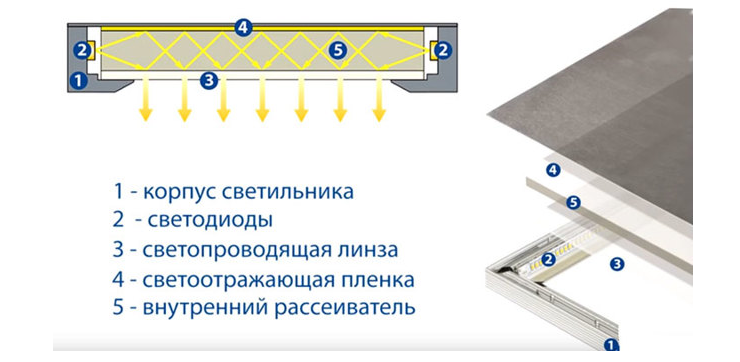
LEDs are located around the perimeter of the case. Overheating is extremely rare. Behind the lens is a reflective film. It is needed to redistribute the light flux perpendicularly down.
Varieties of LED panels
LED panels are:
- rectangular;
- round;
- square.
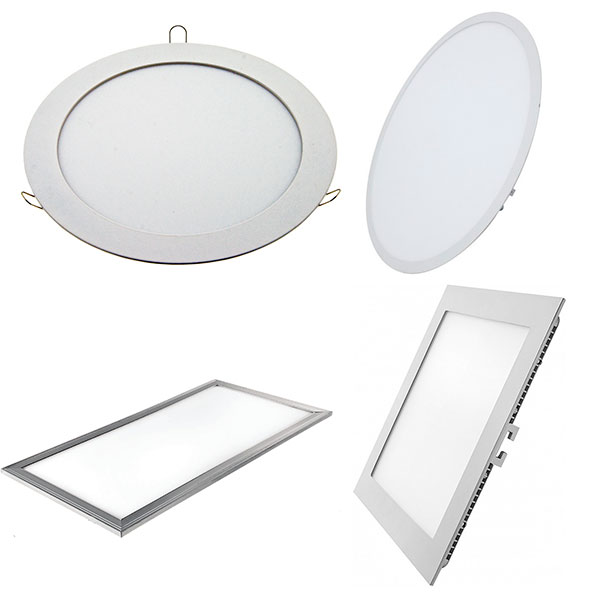
The size can be ordered at your discretion. The average thickness is 1.4 cm. In rooms with low ceilings, it is more expedient to install panels, as they can visually raise it due to a diffuse matte glow. Thin devices, regardless of power and color, are fixed without difficulty in a suspended or overhead position. They can also be combined with spotlights.
The device of almost all panels is the same, only the configuration changes. According to the purpose, the products can be ceiling and advertising (they are found on billboards of the night city).

They are made in the form of a display with diodes that play the role of pixels on the monitor screen. Sometimes it's a cohesive background glow that creates a dynamic image that grabs the attention of potential customers. The effect is achieved by connecting each of the chips to a separate circuit.
Ceiling panels are actively replacing luminaires with fluorescent bulbs, which were installed in offices, from the market. This option is currently not available.In a room where there are practically no voltage drops, diodes can last up to 20 years. When installed on a stretch ceiling, they look original, combined with the design of the room. You can adjust the intensity of the light.
Be sure to watch: Installing an LED panel on a concrete ceiling in a non-standard way, on magnets.
Panel fixings
LED panels can be installed on different surfaces. There are several mounting options:
- on a concrete surface;
- for tension structures;
- on a suspended ceiling.
Each option has features that need to be explored. LED products can be mounted on a tree, but you should choose the right fasteners.
Installation on a concrete ceiling
The main fasteners in this case are suspensions, with which the height is adjusted. Usually come in a kit. If not, they can be easily purchased at the store. One of the important stages of installation is marking on the ceiling. It is necessary to be extremely accurate, otherwise the work will have to be redone.
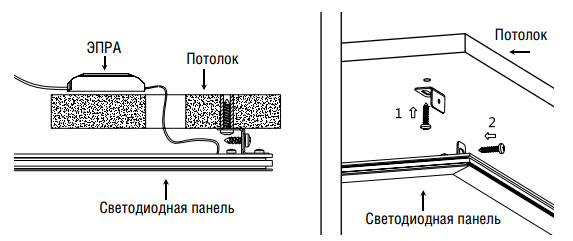
In the process, the main thing is fixing the panel on the same level with the finishing material. To adjust the height, use plastic or wooden lining. Hangers are fastened with self-tapping screws. 3 self-tapping screws are required for each hanger. After that, a lamp is attached to the cable using brackets welded at the corners. A cable should be passed through them, securing with a clamp.
You can purchase steel fasteners in the form of corners. 4 pieces are installed according to the markings on the ceiling, as well as on the corners of the panel, fastened with screws. The dimensions of the corners are selected depending on the distance between the ceiling and the lamp body.
Plasterboard ceiling installation
LED panels are designed to fit in ceiling structures. The main requirement is the compliance with the ceiling plane of the front of the lamp. If the ceiling is rack or panel, a place should be allocated for the lamp and laid with suspensions.
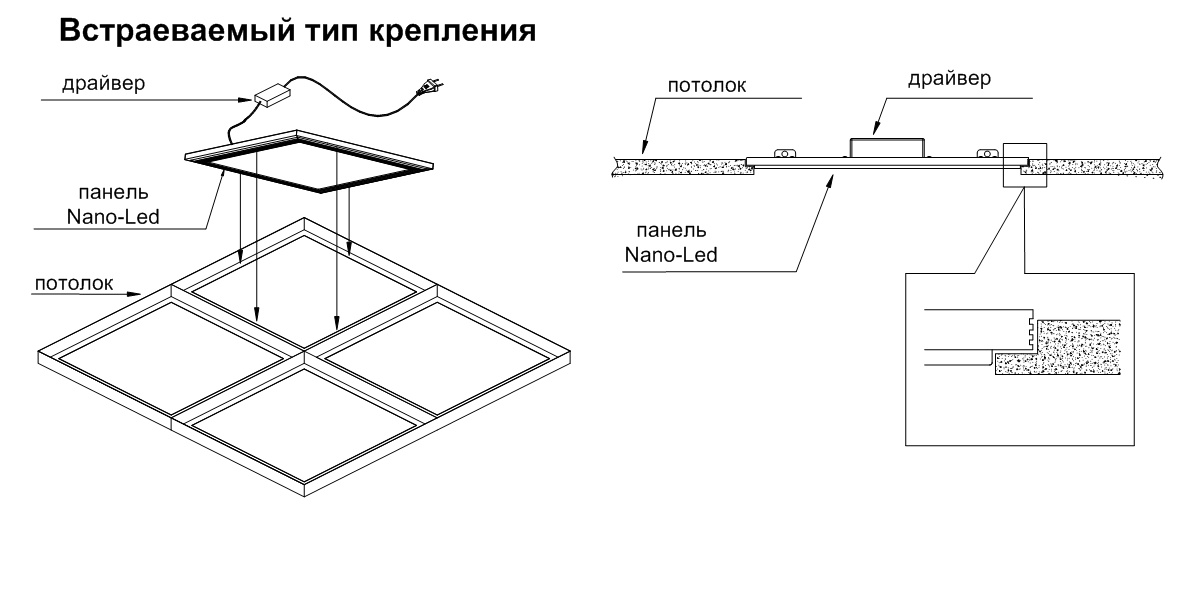
On the plasterboard ceiling, you do not need to cut anything. The best option is the technology of installation on the base surface. During the laying process, the attachment points are determined, metal profiles are installed under the fixtures as a base. After the lamp is attached according to the same principle as on concrete or corners.
Stretch ceiling installation
Installing panels on a stretch ceiling on your own without experience is not recommended, since the technology is more complicated and depends on the materials of the ceiling surface. There are 2 options here, mounting a recessed luminaire or using a cable.
If a cable is selected, markup is drawn and a stretch ceiling is mounted by making 4 holes for the lamps. At the next stage, cables are mounted to which the lamp is attached.
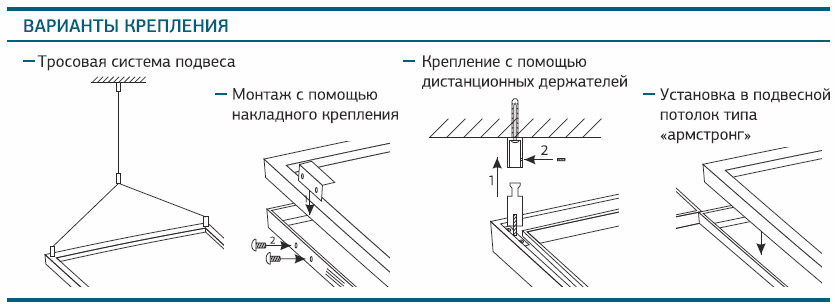
If the first method is chosen, it is necessary to install a base for a metal profile lamp at the level of the stretch ceiling. The installed panel connects immediately. At the next stage, an order is made for the installation of a stretch ceiling, taking into account the presence of a lamp. If this is not possible, the luminaire is attached to the surface with mounting brackets.
Panel connection features
The connection is determined by the driver. If it is in the housing, its output terminals can be connected to the household electrical network. If not, you will have to install it yourself. This can be done on the surface of a building structure or behind a false ceiling. After that, it turns on the LED lamp.
When choosing a driver, it is worth considering:
- input voltage;
- degree of protection. This will depend on the location and mode of operation;
- output voltage;
- output current;
- power. The indicator determines the allowable load.
| Room type | Power of LED lamps (Watt per 10 m2) |
|---|---|
| Living room, bathroom | 30 |
| Bedroom, hallway, corridor | 20 |
| Kitchen | 40 |
| Children's | 50 |
| Utility rooms | 10 |
When installing electrical wiring, you can use double-insulated wire. The main cable with branching can power several lamps at the same time. The main thing is to correctly calculate the power consumption.
Conclusion
LED panels are a modern variety of space lighting devices. They differ from other types of lamps in the area of the luminous flux. One lamp can light up a large room. Installation should be carried out based on the ceiling material and shape.