Step by step installation of solar panels on the roof
Using the energy of the sun to generate electricity or heat water saves on energy resources. In addition, independence from external communications is ensured, problems with the supply of electricity will not be terrible. Installation of solar panels on the roof requires attention, since it is necessary to calculate the number of modules and consider their correct location.
Advantages of a rooftop installation
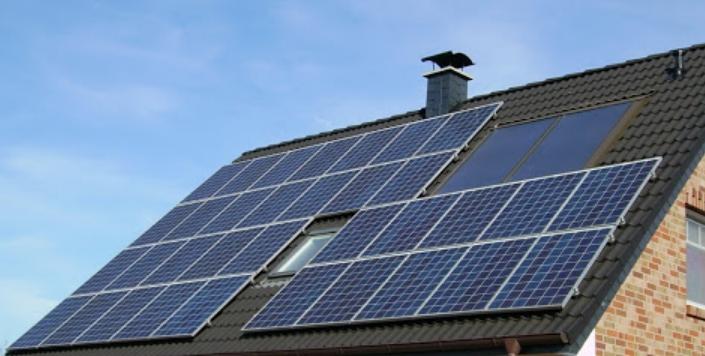
Panels can be placed not only on the roof, but also on the walls or on the ground. But the first option has gained the most popularity, as it has many significant advantages:
- Good position in relation to the sun. The more sunlight hits the surface of the batteries, the more power they produce. The slope allows you to increase efficiency, especially if it is located in a southerly direction.
- Low risk of damage and damage to the panels. Since they are on the roof, they can only be damaged if a stone is deliberately thrown, any accidents are practically excluded.The elements are located at a small distance from the surface, even with a strong wind there is no danger of breaking the fasteners, since the windage is small, unlike systems that are placed on the ground.
- Everything you need for mounting is sold with solar panels. No need to invent fasteners and adapt improvised elements. There are brackets for different types of roofs, which are not difficult to expose and adjust the height. They serve for decades, which is also important.
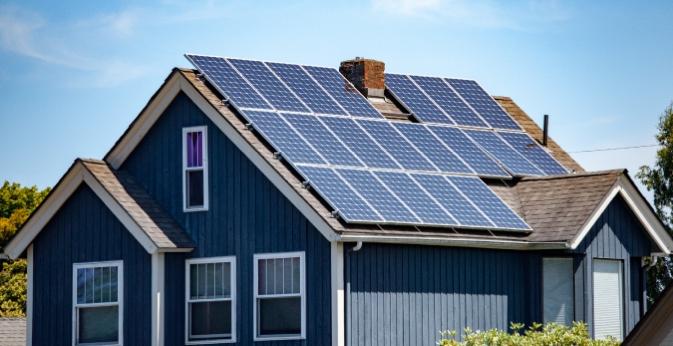
- Solar panels do not take up space on the site. Since the area of the modules is usually rather big, when placing them in the yard, a lot of space is lost. Even if there is an attic floor on the roof, this is not a problem, panels are not attached at the location of the windows and natural light does not suffer.
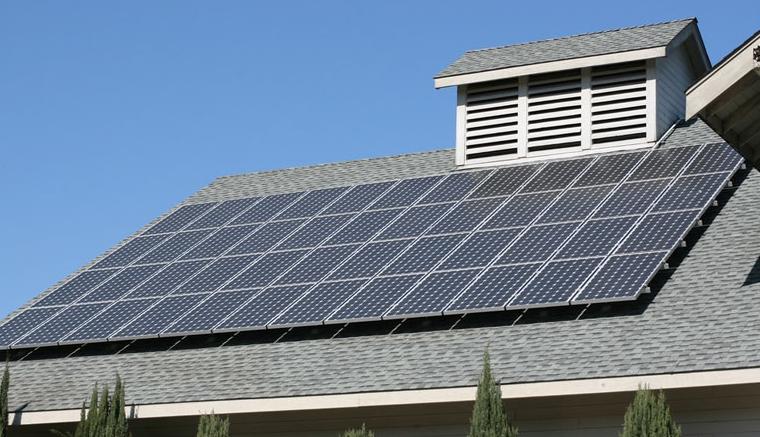
An additional advantage of using solar panels can be considered an increase in the life of the roof by one and a half to two times. Since most of the roof is covered with panels and they are exposed to the sun and precipitation, the roofing material under them hardly deteriorates and retains its properties for decades.
Roof illumination at different times
To provide the house with autonomous electricity, you need to make accurate calculations and determine how many solar panels you need. You need to take the average electricity consumption per day, and calculate the number of panels (it matters how much current they generate). In addition, there are a number of other aspects to consider:
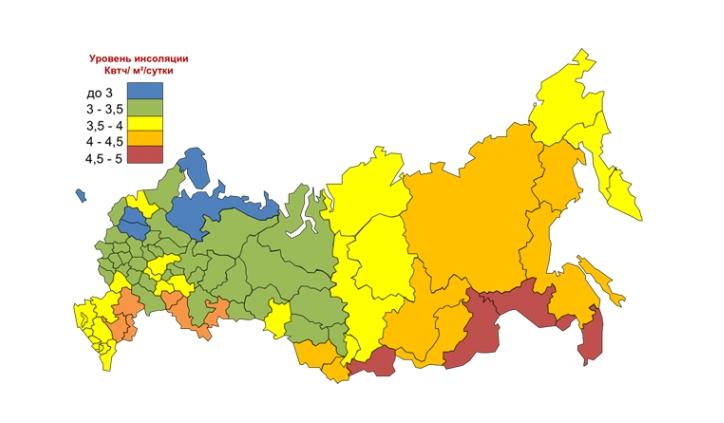
- Insolation - reflects how much solar radiation hits the surface in different regions at different times of the year.It is calculated in kilowatt-hours per square meter per day. Depending on the place, the indicator changes, the scheme with the table is given below.
- To get the maximum amount of electricity, you need to install solar panels on slopes directed to the south, this rule is true for the entire northern hemisphere. The easiest way to find out the orientation of a house is with the help of a compass (download it to your smartphone), or you can look at your house in Google maps. If it is impossible to place the structure exactly to the south, you can choose the southeast or southwest, other options will not work.
- The time of year must also be taken into account. The sun is high in summer and low in winter. To ensure the efficiency of the system, you need to choose the position of the panels in which they will give the best effect throughout the year. Swivel mechanisms can be used, but they are difficult to install and expensive, the increase in efficiency is often not worth the cost.
- During the day, solar panels also receive different amounts of light, so energy is accumulated unevenly. It is necessary that in the period from 10 to 14 hours, as much sun as possible falls on the surface. Ideally, the roof should be lit all day, even if not at an ideal angle.
- If there are trees and other objects nearby that can cast a shadow, you need to eliminate them. And if the house is shaded by multi-storey buildings, then there is no point in installing solar panels, since the effect of them will be minimal.
What fasteners will be needed
Fastening depends on the type of roof and roofing material. Choosing a fastener is not difficult if you understand its features. There are few options, each with its own nuances:
- The panels themselves are mounted on special guides, which are usually suitable for all types of fasteners. That is, this part of the structure is always the same and does not depend on the type of roof and roofing material. To simplify work and reduce the load on the roof, the guides are made of aluminum or alloys based on it.
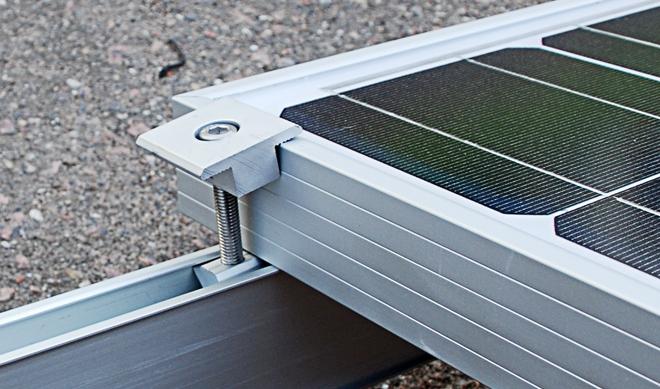
- The clamps fixing the panels are also always the same. They are mounted in the guide and, due to the legs of a special shape, press the body to the surface. They can be divided into single-sided, which are placed along the edges and double-sided, used between panels.
- For reliable docking of the guides, special connectors are made. Also, the design always has ground terminals that combine the entire frame into a common circuit and ground it.
![Step by step installation of solar panels on the roof]() Mountings for solar panels on bituminous tiles.
Mountings for solar panels on bituminous tiles. - Under the roofs, on which the joints are made in the form of folds, as well as for any metal options with protrusions, fasteners are used that do not violate the roof surface. The clamp is fixed on the ledge with a screw and thereby holds the structure.
- For metal tiles and corrugated board, fasteners are used that violate the integrity of the material. In this case, special metal screws are used, under which it is desirable to drill holes. Ideally hit in a metal or wood frame under a coating to provide strength. To prevent water from leaking at the attachment point, washers with a rubber spacer are required.
- If there is a clay tile or other piece version on the roof, brackets are installed that go under the surface and do not damage the structure. Usually you need to remove the element, set the mount so that it does not interfere with laying the tiles in place.The same solutions are suitable for a flat roof, if possible, do not damage it.
- For flexible tiles, smaller options are used, which also go under the surface. It is best to put them when installing roofing material. But even then, you can bend individual fragments to install fasteners and not damage the roof.
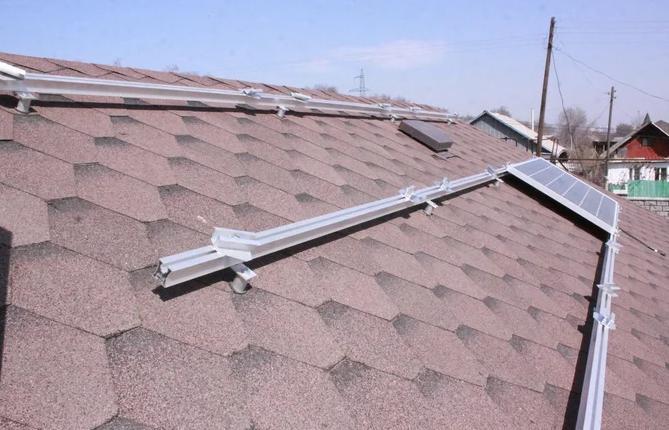
Do not use homemade fasteners - if they ruin the panels, you will have to change them at your own expense.
Mounting on pitched roofs with various types of roofs and using aluminum fixing elements.
Installation - step by step instructions
It is better to buy all components from one seller, when choosing from several, take into account the data from the project, which must be done before starting work. Usually, calculations are done for free, it is better to entrust this to specialists. It is also worth contacting the organization supplying electricity in advance and obtaining permission to install the system.
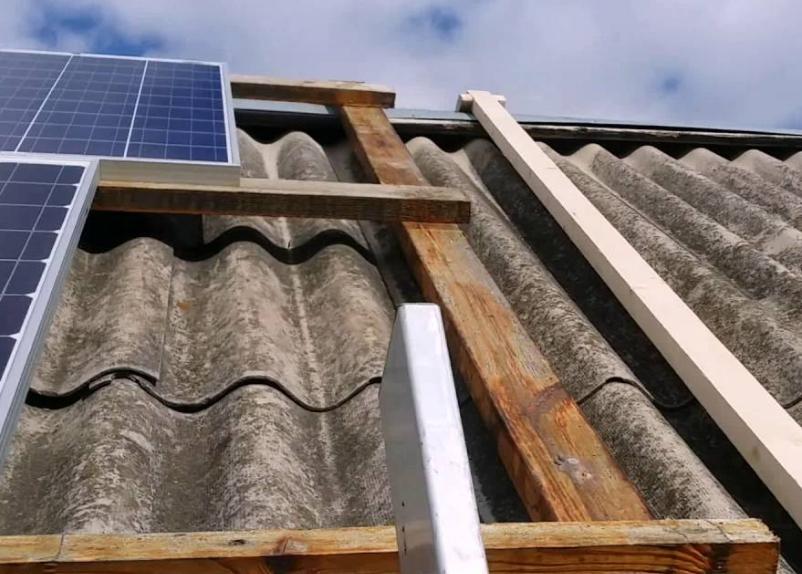
Carrying out work by specialists on average costs about 100,000 rubles, if you manage on your own, you can save a lot. The main thing is to do everything according to simple instructions:
- Plan the location of the panels on the roof, it all depends on the number and configuration of the slope. Think over the location of the mounts, choose a convenient option in accordance with the size of the solar panels. It is best to draw at least the simplest plan, so that later you do not get confused and know where to put the fasteners.
- Accurately determine the location and fix the brackets, it all depends on the type of roof. Use any suitable fasteners, usually fast-mounting dowels, wood screws or special screws for metal roofing.Do not forget to check the distance and installation step of each part.
![Step by step installation of solar panels on the roof]() Special fasteners are inserted into the groove of the guide and clamped with a hexagon.
Special fasteners are inserted into the groove of the guide and clamped with a hexagon. - Set up guides. If the brackets are as expected, then there will be no problems with this stage. Everything is done with standard fasteners, set according to the level, this is the most important requirement. Due to the adjustable elements, you can change the position of the guides.
- Lay wires. Use a quality cable that is suitable for the characteristics, usually the data is in the project. Think about how to launch it from the roof and put it around the house to all the necessary nodes. If necessary, use a corrugated sleeve that will prevent fire during short circuits. Do not forget about grounding, do it according to the recommendations of the seller of the kit.
- Determine the location of the inverter with the charge controller. The closer it is to the batteries, the less electricity will be lost and the more efficient the system will work. Therefore, it is advisable to place it in the attic, equipping the space, for protection, you can build a box. To make it more convenient to control the system, it must be equipped with a wireless connection module, then it will be possible to view all indicators via the Internet using a computer or smartphone.
- Equip a room with batteries, a fuse box and a disconnect switch to disconnect from the mains if maintenance is required. It must comply with safety standards, it is best to close the door with a lock if there are children in the house. Select the battery capacity depending on the power consumption.
- Mounting the solar panels on the roof is best done with a couple of helpers, as the panels need to be carefully lifted and supported during installation. Use standard fasteners, each element must have at least 6 fastening points. Put in order so that the installed parts do not interfere with the installation of the following, do not forget to connect each panel after mounting.
An electrician must connect the system to the network, if you do it yourself, you will be fined.
There may be other features, it all depends on the design of the roof and the equipment used. It is better to consult with a specialist, or entrust some of the most difficult work to professionals so as not to spoil anything.
Video: Installation and connection diagram.
Service
Most of the work can be done on your own, but it is advisable to involve a specialist at least once a year so that he checks the condition of the equipment and, if necessary, carries out routine repairs. Follow simple guidelines:
- Check the condition of the fasteners, their reliability, evaluate the appearance of the panels and inspect them for damage.
- It is advisable to wash the panels at least once a month, dust and dirt reduce work efficiency, energy losses can be from 5 to 20%. Washing should be done with an ordinary hose with a nozzle, if necessary, you can gently wipe it with a soft mop, but do not press on the surface.
- Inspect contacts and connection points. Over time, they can weaken or oxidize. Pay attention to joints in the open air. Remember to check the ground connections of the system, they too can deteriorate over time.
- Clean the inverter from dust - if this is not done, it will start to overheat.Also check the electronics for failures and errors.
- Once a quarter, measure the battery charge level, and once a year, check the density of the electrolyte, if any.
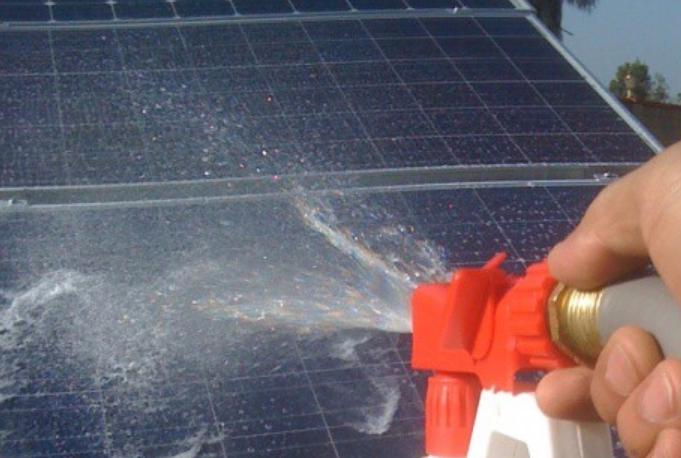
In case of problems and failures, it is better to contact specialists in order to eliminate them at the very beginning. Constantly check the readings through a computer or smartphone, there is all the information you need to control.
Installing solar panels on the roof of the house with your own hands is not difficult if you follow the instructions and purchase everything you need for work in advance. The more detailed the project is, the better, you should not do everything as it will, as the system is unsafe. Remember that the inverter should be placed as close as possible to the energy collectors, if possible.