What is called dispersion of light
This phenomenon was discovered in 1672 by Isaac Newton. Until then, people could not explain why the colors are arranged in a certain order when refraction. The dispersion of light at one time helped to prove its wave nature, but to understand the issue better, you need to understand all aspects.
Definition
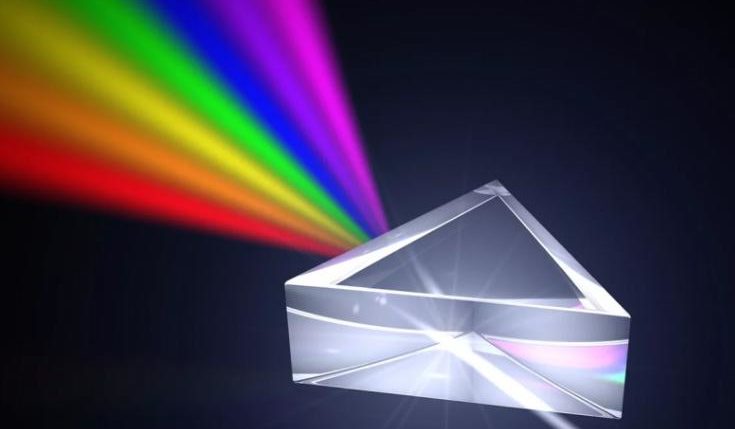
The phenomenon of light dispersion (or decomposition) is due to the fact that the refractive index directly depends on the wavelength. Newton was the first to discover dispersion, but most of the theoretical base was developed by scientists in a later period.
Thanks to dispersion, it was possible to prove that white light consists of many components. To put it simply, a colorless sunbeam, when passing through transparent substances (crystal, water, glass, etc.), is decomposed into the colors of the rainbow that it consists of.
As a result of light entering from one substance into another, it changes the direction of movement, which is called refraction.White color contains the whole range of colors, but it is imperceptible until it is subjected to dispersion. Each of the composite colors has a different wavelength, so the angle of refraction is different.
By the way! The wavelength of each of the colors of the spectrum is constant, therefore, when passing through a transparent substance, the shades always line up in the same order.
History of discovery and conclusions of Newton
The story tells that the scientist first noticed that the edges of the image in the lens are colored during the period when he was improving the design of telescopes. This interested him greatly and he set out to reveal the nature of the appearance of colored bands.
At that time, there was an epidemic of plague in Great Britain, so Newton decided to leave for his village of Woolsthorpe in order to limit his social circle. And at the same time to conduct experiments to find out where different shades come from. To do this, he captured several glass prisms.
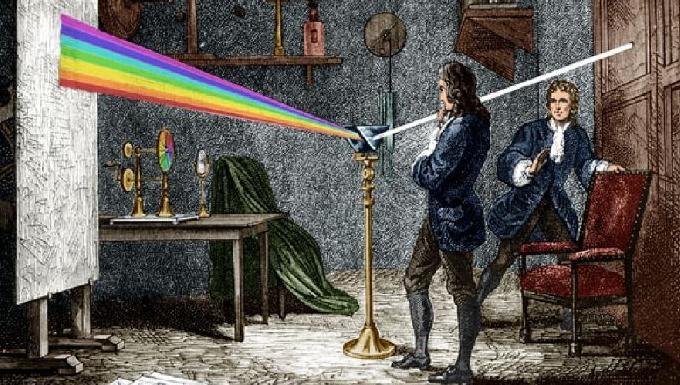
During the period of research, he conducted many experiments, some of which are still being carried out unchanged. The main one looked like this: the scientist made a small hole in the shutter of a dark room and placed a glass prism in the path of the light beam. As a result, a reflection in the form of colored stripes was obtained on the opposite wall.
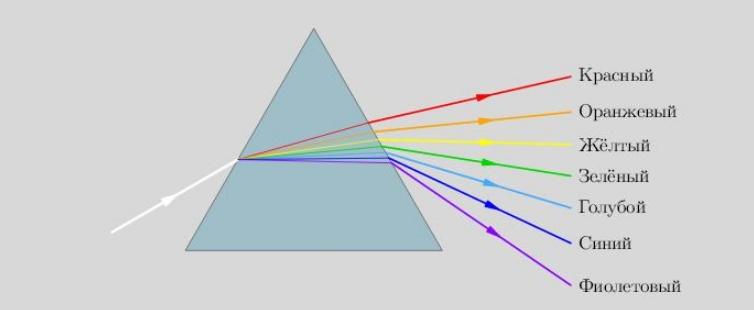
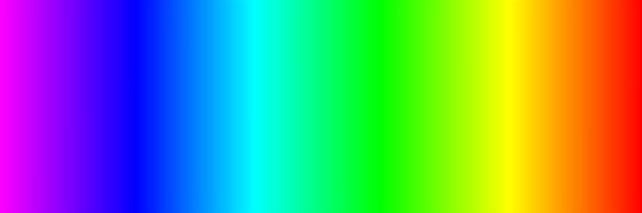
Newton singled out red, orange, yellow, green, cyan, indigo and violet from the reflection. That is, the spectrum in its classical concept. But if you look in more detail and highlight the range of modern equipment, you get three main zones: red, yellow-green and blue-violet.The rest occupy small areas between them.
Where is found
Dispersion can be seen much more often than it seems at first glance. You just need to pay attention:
- Rainbow is the most famous example of dispersion. Light is refracted in water droplets, resulting in a rainbow, which experts call primary. But sometimes the light is refracted twice and a rare natural phenomenon appears - a double rainbow. In this case, the inside of the arc is brighter and with the standard order of colors, while the outside is blurry and the shades go in the reverse order.
- sunsets, which can be red, orange, or even multicolored. In this case, the object that refracts the rays is the Earth's atmosphere. Due to the fact that air consists of a certain mixture of gases, the effect is different and can be different.
- If you look closely at the bottom of an aquarium or large body of water with clear transparent water, you can clearly distinguish iridescent highlights. This is due to the fact that the solar range, due to diffusion, is decomposed into the entire color spectrum.
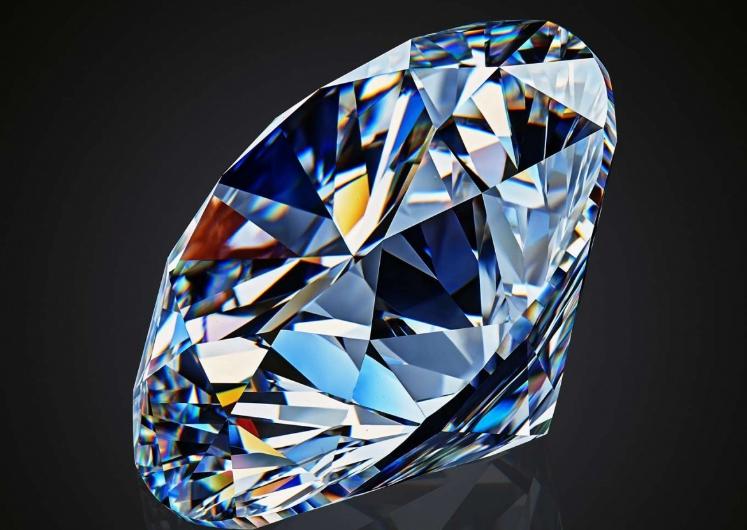
- Gems with jewelry cut also shimmer. If you gently rotate them, you can see how each face gives a different shade. This phenomenon is noticeable on diamonds, crystal, cubic zirkonia, and even on glassware with good cut quality.
- glass prisms and any other transparent elements, when light passes through them, also give an effect. Especially if there is a difference in lighting.

To show children the phenomenon of dispersion, ordinary soap bubbles can be used.The soapy solution must be poured into a container, and then any frame made of wire of a suitable size should be lowered. After extraction, iridescent overflows can be observed.
The decomposition of light into a spectrum is easy to do with the help of a smartphone flashlight. In this case, you will need a glass prism and a sheet of white paper. The prism must be placed on a table in a dark room, on the one hand, direct a beam of light at it, and on the other, put a piece of paper, there will be colored stripes on it. Such a simple experience is very popular with children.
How the eye distinguishes colors
Human vision is a very complex system capable of distinguishing part of the electromagnetic spectrum. The human eye distinguishes wavelengths from 390 to 700 nm. Electromagnetic radiation in the visible range is called visible light or simply light.

Colors are distinguished by rod and cone cells in the retina. The first type has high sensitivity, but is able to distinguish only light intensity. The second one distinguishes colors well, but works best in bright light.
At the same time, cone cells are divided into three types, depending on which waves they are more sensitive to - short, medium or long. Due to the combination of signals coming from all types of cones, vision can distinguish the range of colors available to it.
Each type of cell in the eye can perceive not a single color, but different shades in a wide range of wavelengths. Therefore, vision allows you to highlight the smallest details and see all the diversity of the surrounding world.
The dispersion of light at one time showed that white is a combination of the spectrum.But you can see it only after it is reflected through certain surfaces and materials.