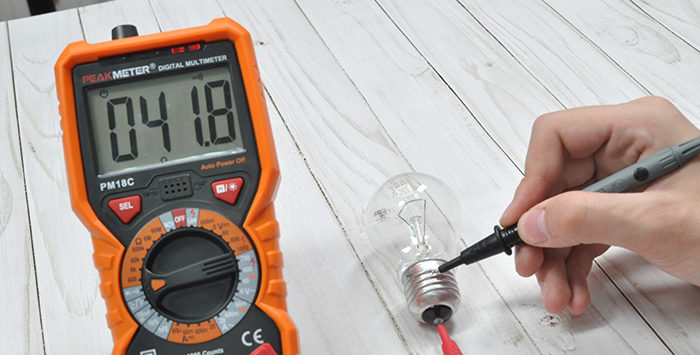
Checking a light bulb with a tester
Bulb burnout - not the most pleasant event, which entails inconvenience and costs for new sources of lighting. But far from always, the malfunction of the lamp is caused by the breakdown of the element. Often the cause is the failure of other components of the circuit, a short circuit or a violation of the integrity of the wiring. In order not to throw away a serviceable element in vain, the light bulbs are checked with a multimeter.
Do I need to check the light bulb
Inspection of the light bulb does not always allow you to accurately determine the malfunction. Even in incandescent lamps, in some cases the tungsten filament remains in place without any damage. But at the same time, the device does not function in the desired mode.
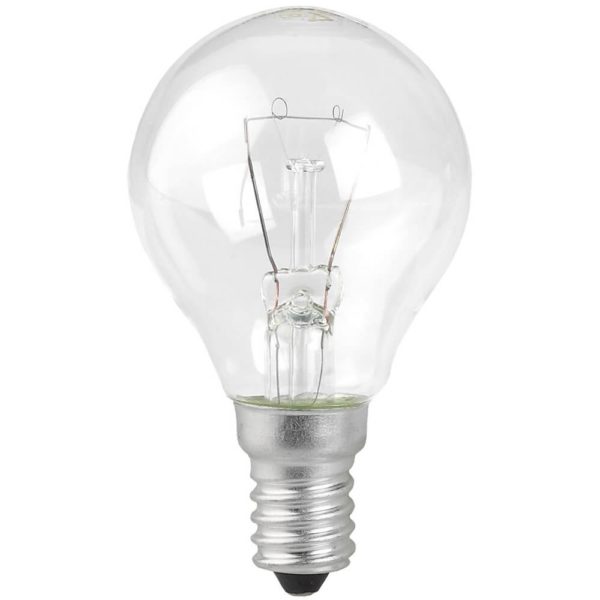
So LED or fluorescent lamps is even more difficult, since the internal parts of these elements are usually hidden by the opaque glass of the bulb. And even if they were visible, it would be difficult to establish a malfunction. But you can detect a breakdown with the help of testers.
If a problem occurs in a particular lamp, the easiest way is to unscrew the light bulb from the cartridge and screw it into another lighting device. If it lights up, then the problem is in the lamp. However, the procedure is not always possible. Often in apartments there may be devices with specific bases that are not suitable for other cartridges.
It will be useful to know: Why do the light bulbs in the chandelier burst.
In good electrical stores, sellers always check with a tester before selling the lamp. Especially for this, they provide connectors for each type of light bulbs (incandescent, halogen, fluorescent and LED).

Using a tester, a specialist checks the integrity and serviceability of all conductors inside the lamp. The test is accompanied by a characteristic signal. The same check can be carried out by any user at home. This requires a multimeter or indicator screwdriver.
Checking a light bulb with a multimeter
A multimeter is a device that can measure various indicators of electrical circuits: voltage, current and resistance. There is also a dialing mode, which is used to check the integrity of the conductors. Using a multimeter, you can quickly check any electrical equipment and accurately localize possible faults.
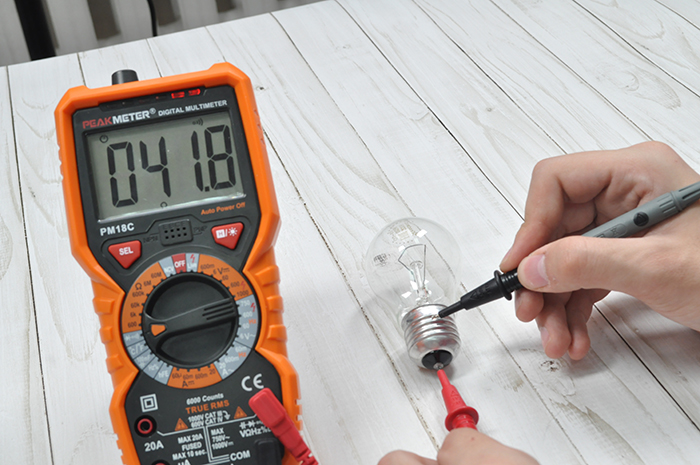
It is easiest to check the light bulb with a multimeter in the dialing mode. It involves sequential testing of circuit elements for the presence of contact between them. In the vast majority of multimeters, the mode is built-in by default. To activate it, the user needs to move the switch to the desired position.Usually there is a diode or buzzer icon opposite.
When connecting the probes, it is important to observe the correct connections. The black caliper is inserted into the hole marked "COM" with a ground symbol. The red probe is located in the hole marked "VΩmA".
The probe tips must be closed and wait for the characteristic buzzer signal to appear. Zeros will be displayed on the screen at this moment, indicating that there is no excess resistance or gap. An open circuit will give a value of "1".
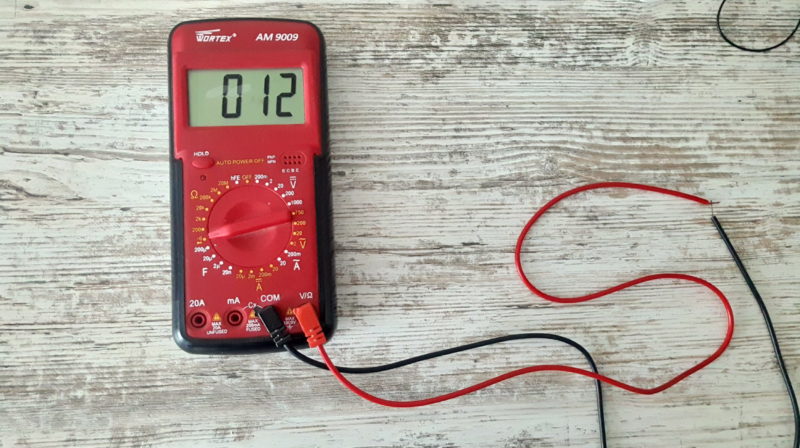
Checking a light bulb with a tester
You can check the light bulb in the continuity or resistance measurement mode. Both methods are able to provide the necessary information about the state of the electrical appliance and help identify the malfunction.
Call mode
The mode is provided in all multimeters. On the panel, it can be found by a characteristic symbol.
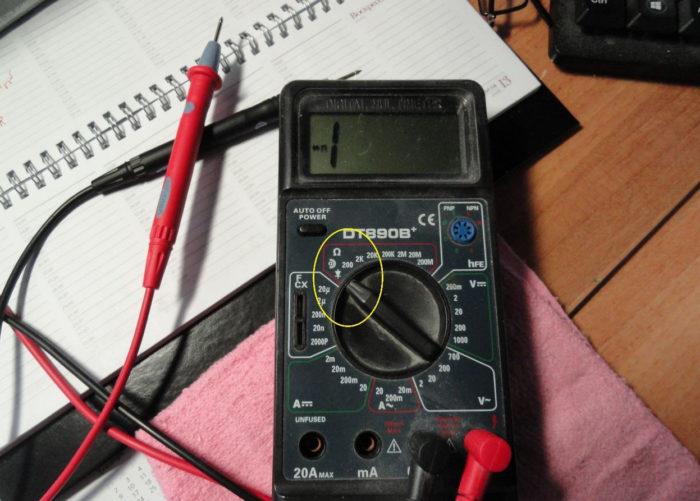
One probe of the device is applied to the central contact of the lamp, the other to the side (for sources with a threaded base). If the device uses a pin base, you just need to attach the meters to the appropriate pins.
If the lamp is working, a sound signal will follow, the value on the display will be in the range from 3 to 200 ohms.
Before ringing the lamp, it is recommended to briefly close the probe contacts to each other. This is how the measuring module of the tester is checked.
Small fluorescent or LED elements (for example, 12 volts) cannot be checked by this method. This is due to the presence of a special electronic circuit in the interior of the base.In this case, if the tester does not respond, any part of this circuit could fail. To check, it is advisable to disassemble the light bulb and gain access to the main circuit.
Related video: How to check an incandescent lamp yourself
Resistance test mode
It allows you to determine with high accuracy the health of the light bulb, as well as to make sure that the indicators comply with all standards. So, you can easily determine the power of a particular electrical device, even if the mark on the flask or base has been erased for some reason.
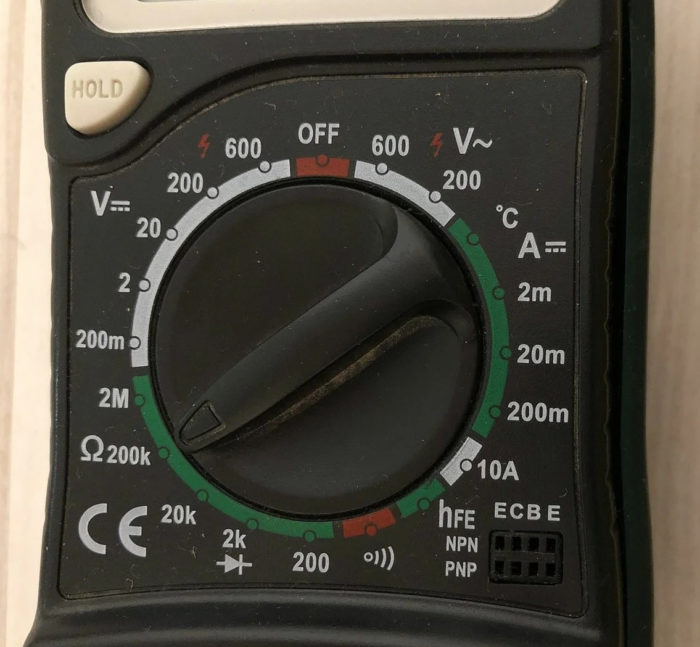
The tester switch must be moved to the position opposite the 200 Ohm marking. Then the probes touch the contacts of the light source in the same way as it was done in the continuity mode. But in this case, no signal will follow, and the resistance value will appear on the screen. The number "1" indicates a break inside the light bulb.
According to the measured resistance, we can draw a conclusion about the power of the lamp. To do this, use the table for incandescent lamps below.
| Power, W | 25 | 40 | 60 | 75 | 100 | 150 |
| Resistance, Ohm | 150 | 90-100 | 60-65 | 45-50 | 35-40 | 25-28 |
When measuring, it is important to remember that such measurements imply not very reliable contact between the probe and the tester. Therefore, the actual result may differ slightly.
It will be interesting to read: Soft start device for incandescent lamps.
Checking with an indicator screwdriver
An indicator screwdriver may well replace a multimeter if you need to check the light bulb as quickly as possible. To begin with, it is recommended to make sure that the screwdriver itself is working. To do this, touch its metal contacts on the sides. This action should cause the LED inside to light up.
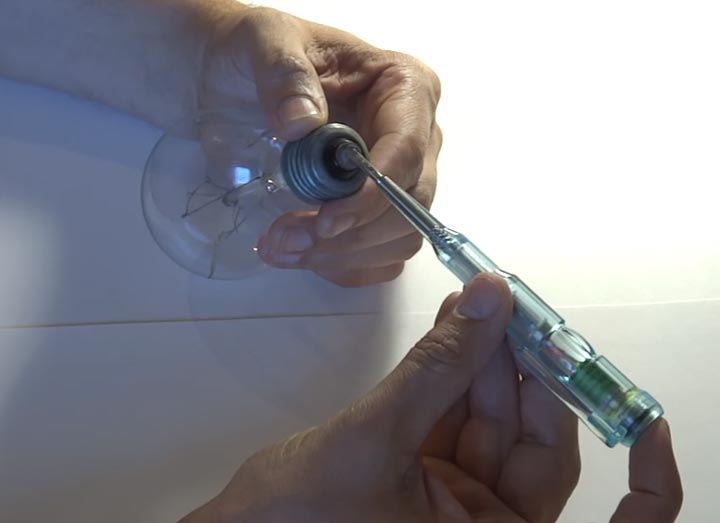
The procedure for checking the lamp with an indicator screwdriver:
- In one hand, a light bulb is taken by the side thread.
- With the other hand, you need to take a screwdriver and touch the metal part to the central contact. The thumb of the same hand touches the end of the screwdriver.
- The circuit is completed through the lamp and the body, which causes the LED to light up. If nothing happens, the lamp is faulty.
It is most likely that it will not be possible to identify a malfunction of an LED or fluorescent lamp in this way, since the design of such elements includes a complex electrical circuit with a set of ballasts, resistors, capacitors and other components. You can check them only by applying operating voltage to the contacts.
We advise you to read: What light bulbs are best for the home.