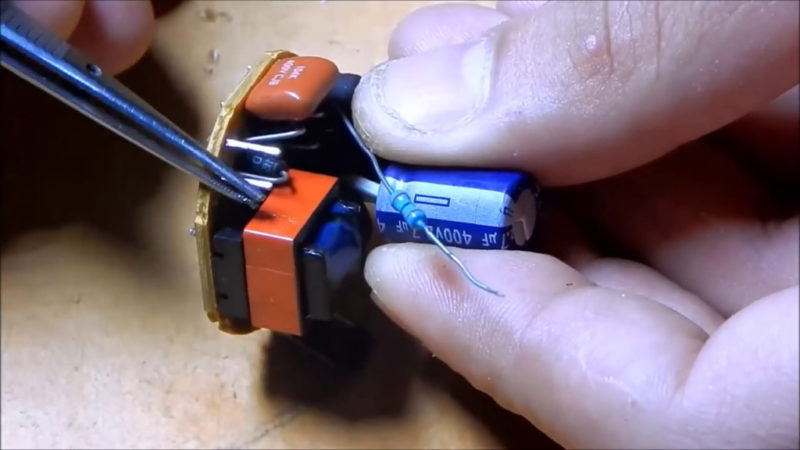
Why does the energy-saving light bulb flash when the light is off?
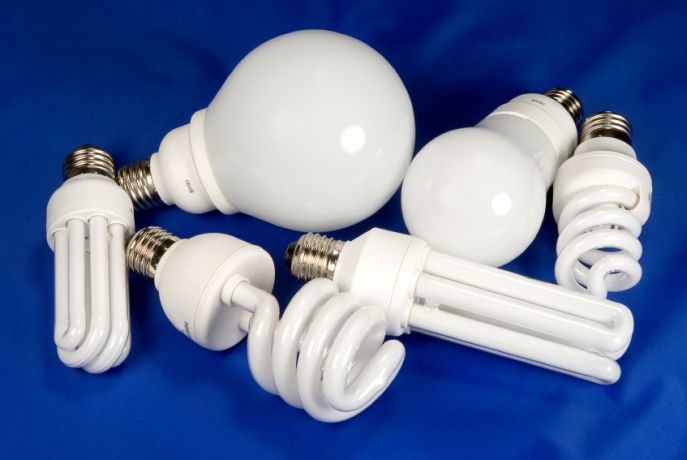
Energy-saving lamps enjoy some success in the lighting equipment market. Although it is believed that they outright lost the competition to LED equipment (mainly due to expensive disposal), the demand for such lamps is still high. But some users have encountered an annoying phenomenon - the energy-saving lamp blinks even when the light is off. To eliminate this problem, you need to find out its causes.
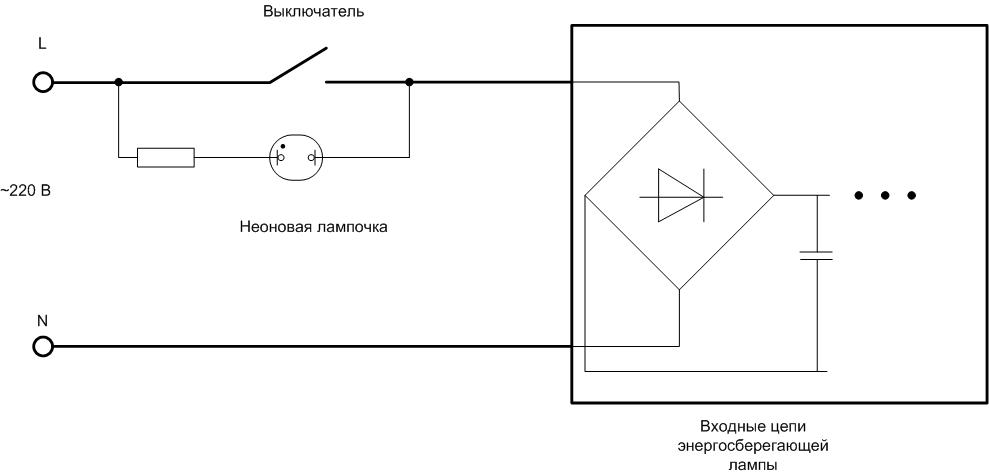
Illumination on the switch
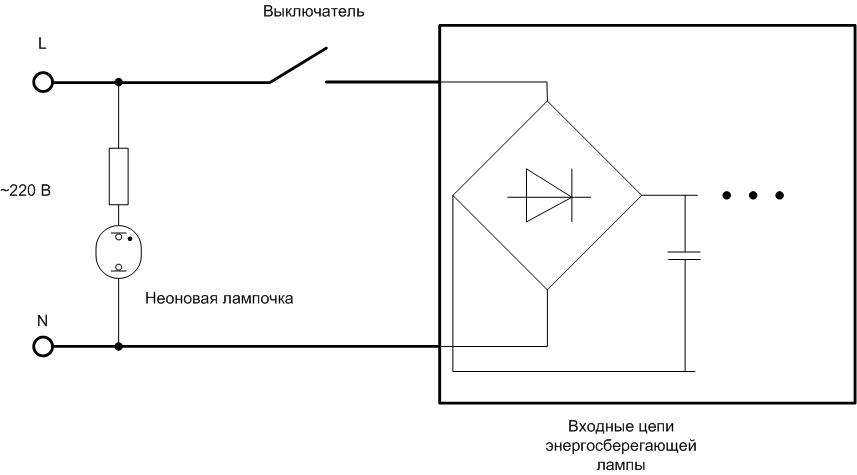
Illuminated switch looks aesthetically pleasing and creates additional convenience - when the light is off, it is easier to find. The lighting circuit is based on a neon lamp or LED and creates a small current through the chandelier even when it is turned off. From the point of view of winding the electric meter, this current is almost imperceptible. He can't even light an incandescent lamp. For the glow of the energy saver, more power consumption is also needed, but an unpleasant effect still occurs.
It's all about the scheme of such a lamp.It is powered by a rectified voltage of 220 V, and a smoothing capacitor is installed after the rectifier. A capacitor has the ability to accumulate energy, and then, when a certain threshold is reached, give it away at once. At this moment, a short-term glow appears in the bulb of the lamp.
To defeat this phenomenon, there are different ways:
- Delete highlight chain. Solder or just bite. Or replace the switch with a device without additional elements.
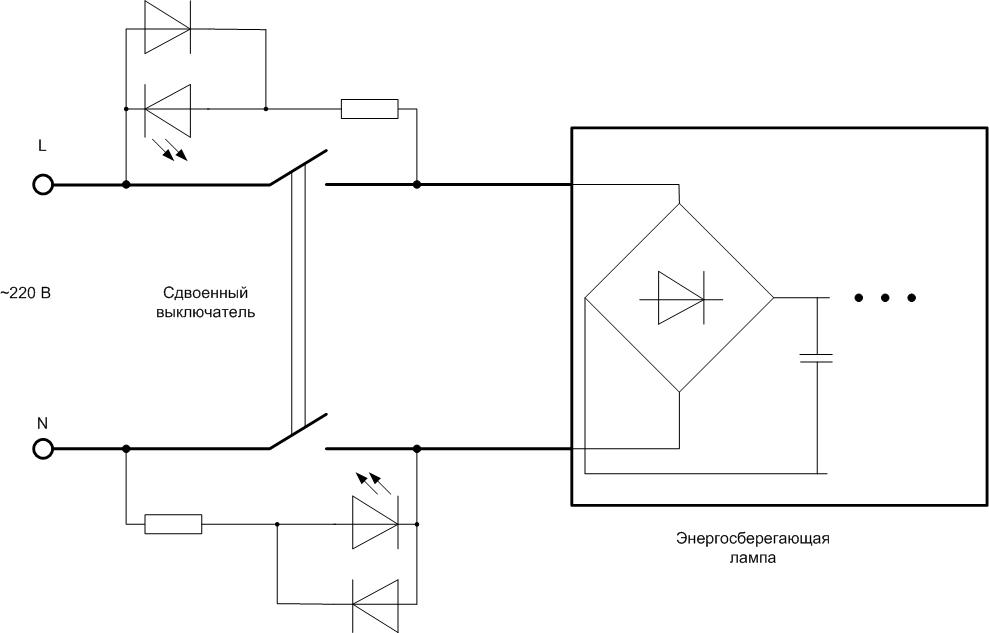
- If the backlight needs to be left, it is possible to switch both the phase wire and the common one when the lamp is turned on and off. Then the circuit for the charge current will be interrupted and the unpleasant flashing will stop. It is difficult to buy a household appliance of this type, and a production one is unlikely to fit into the interior. Therefore, you can take a two-key switch, connect it to the gap of each wire, and instead of two keys, install one, taking it from a device of the same manufacturer. If this is not possible, then the keys can be invisibly connected mechanically.
![Why does the energy-saving light bulb flash when the light is off?]() Two wire break switch
Two wire break switch - You can also reconnect the lighting circuit so that it is constantly connected to the network. In this case, it will not go out when the lights are on, but this drawback is unlikely to annoy anyone. Although energy consumption will increase, it will remain at the same microscopic level.
![Why does the energy-saving light bulb flash when the light is off?]() Alternate backlight activation
Alternate backlight activation - There are situations when an energy-saving element is used in parallel with other light bulbs (for example, in a spotlight system). In this case, you can replace one of the lamps with an incandescent bulb.It will shunt the rest of the elements with a cold thread, the current will flow through it, and the charge will not accumulate in the input capacitors.
- Connect a resistor in parallel with the lamp, with a resistance of about 50 kOhm and a power of 2 or more watts. In this case, one additional element per group of lamps is also sufficient. Parasitic current will go, for the most part, through this resistor.
Wiring error
It happens that the energy-saving lamp flashes even after turning off due to improper installation, when the switch breaks not the phase, but the neutral wire. In this situation, the lamp remains energized, and the current sufficient to periodically charge the capacitor is created by leakage. They can occur for two reasons:
- due to old insulation that loses its performance properties;
- due to capacitive current.
Important! This situation requires immediate correction also for security reasons. With a broken zero, the lamp will not glow, creating the illusion of a lack of voltage. This may result in electric shock during repair work.
To eliminate the problem, the installation should be redone in the nearest convenient place (on the terminal block or in the junction box), but before the switching element. It is necessary to swap the phase and neutral wires.
Recommended for viewing:
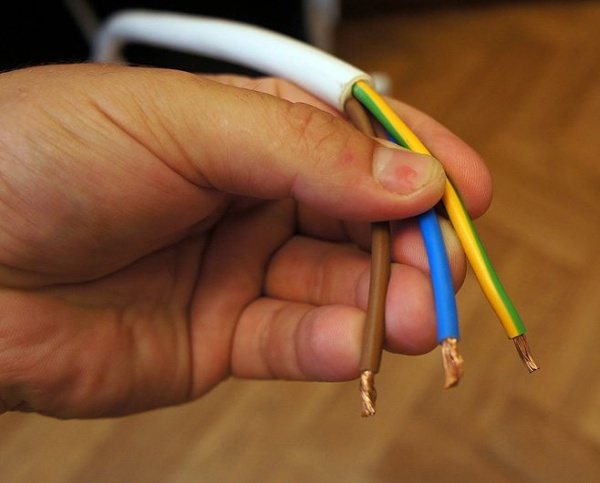
A sign of professionalism is the use of cables with different colors of wire insulation and compliance with the color standard:
- the blue wire is the installation of the neutral wire;
- brown - phase;
- if there is a ground conductor, yellow-green color is used for it.
If an electrician develops the habit of strictly following the rules, the probability of an error during installation is greatly reduced.
But parasitic capacitance cannot be eliminated in this way, and in some cases flashes can continue due to the fact that the voltage of the neutral wire relative to the ground is almost never equal to zero. It can be several volts or even a dozen or two volts. Through capacitive coupling, a current will be created in the circuit, which can accumulate in the input capacitor and create flashes. To eliminate this effect, you can try the measures from the previous paragraph: break both circuits or shunt the lamps with an incandescent lamp (resistor).
Poor quality lamp
Often the lamp fails and starts flashing simply due to the use of low-quality materials for insulating wires, cheap consumables for soldering circuit components (flux, etc.), violations of production technology (poor washing of boards, etc.). All this leads to unpredictable results during operation, including the occurrence of leaks. Therefore, you should buy lamps from well-known manufacturers, although they are somewhat more expensive. A variant of the rating of manufacturers of energy-saving lighting devices is shown in the table:
| Place | 1 | 2 | 3 | 4 | 5 |
| Manufacturer | Philips | LIGHTSTAR | UNIEL | OSRAM | camelion |
| Country | Netherlands | Italy | China | Germany | Hong Kong |
You also need to pay attention to the Russian brand Era.
It should be noted that when disassembling failed lamps, traces of condensation accumulation are often found. Most luminaires have a non-hermetic design, which eventually leads to massive failure of lamps that are operated in conditions of high humidity. This can also cause current leakage inside the energy-saving control circuit.
Important! This method does not require additional costs, it only needs a spare lighting element. In order to save time and money on troubleshooting, it is recommended to do a trial lamp replacement first. Further diagnostics should be carried out in case of an unsuccessful outcome.
Preventive measures
Whatever the reason for the flashing of the lamp, this phenomenon causes not only a feeling of discomfort. The problem is that the resource of the lamp is being developed so quickly. It is consumed in a few months, after which it is necessary to purchase a new and far from cheap lamp again.
Any problem is easier to prevent than to fix. Therefore, the following preventive measures are suggested to reduce the likelihood of a flashing effect when the voltage is removed:
- Purchase only high-quality energy-saving devices from well-known manufacturers.
- If you do the installation yourself, follow the correct wiring diagrams. If a third-party specialist is involved in the work, supervise his work.
- Monitor the condition of the wiring.
- Use only hermetically sealed lamps in damp rooms.
The existence of energy-saving lamps on the market seems to be coming to an end. They lost the competition to LED lamps in all respects and incandescent lamps in terms of price and environmental friendliness. But the energy-saving devices that remain in operation can still serve the owners. They just need to be used correctly.