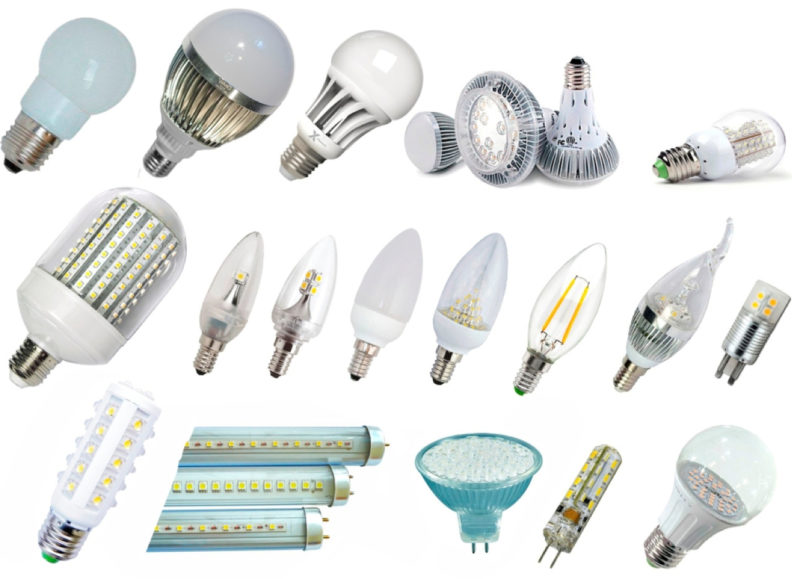
Designation of LED lamps
The purchase of LED lamps in most cases does not cause problems for buyers. Many do not even try to understand the markings on the packaging, while others simply do not understand the meaning of the presented character set. And yet, they play an important role. Failure to take into account these parameters can lead to the acquisition of an inefficient, inconvenient or simply unsuitable light source. For this reason, the labeling of lamps must be considered with the utmost care.
Light flow
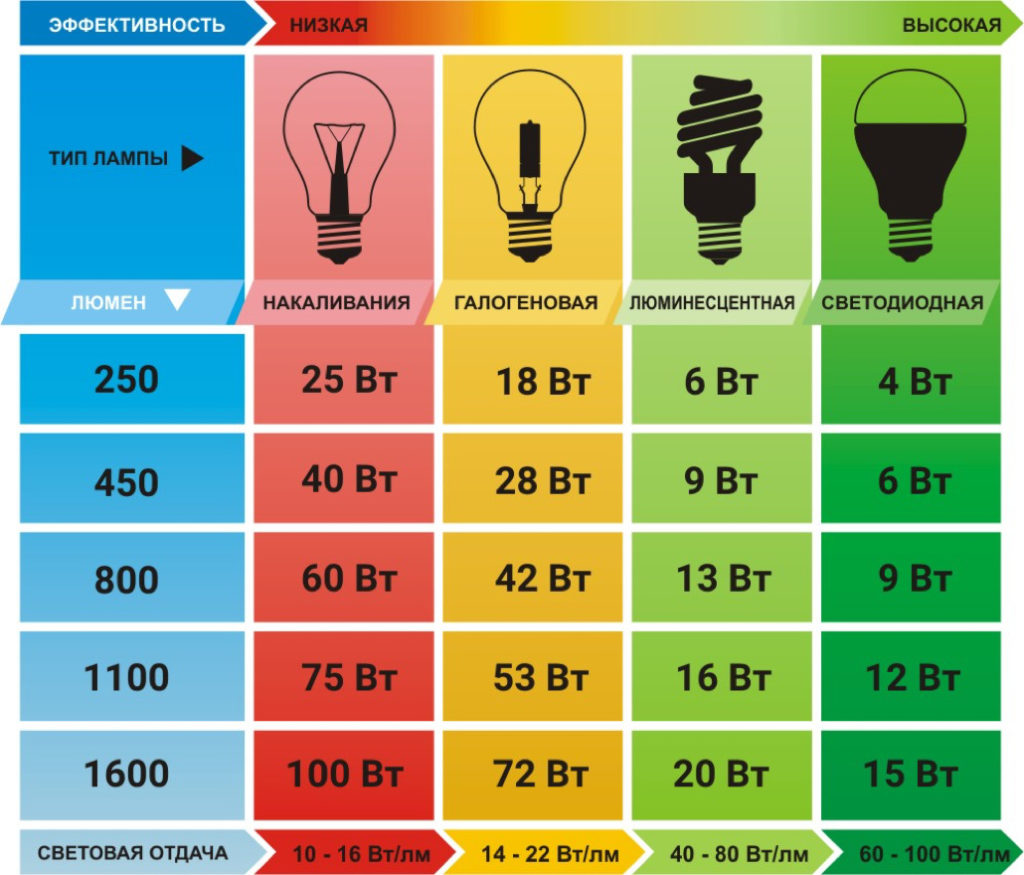
Luminous flux is a parameter of the glow power of an LED device, measured in lumens. The characteristic allows you to determine the effectiveness and efficiency of a particular model in the specified operating conditions.
According to the luminous flux, LED devices are compared with incandescent lamps and other light sources. For this, special tables are used.
The power of the luminous flux is several times higher than that of other light sources.When selecting models according to these parameters, one should not forget that after working out the operating time, LED models significantly lose their brightness.
Type of flask and base
The LED lamps offered to customers differ in the shape and size of the bulb. These parameters are determined by specific values on the box.
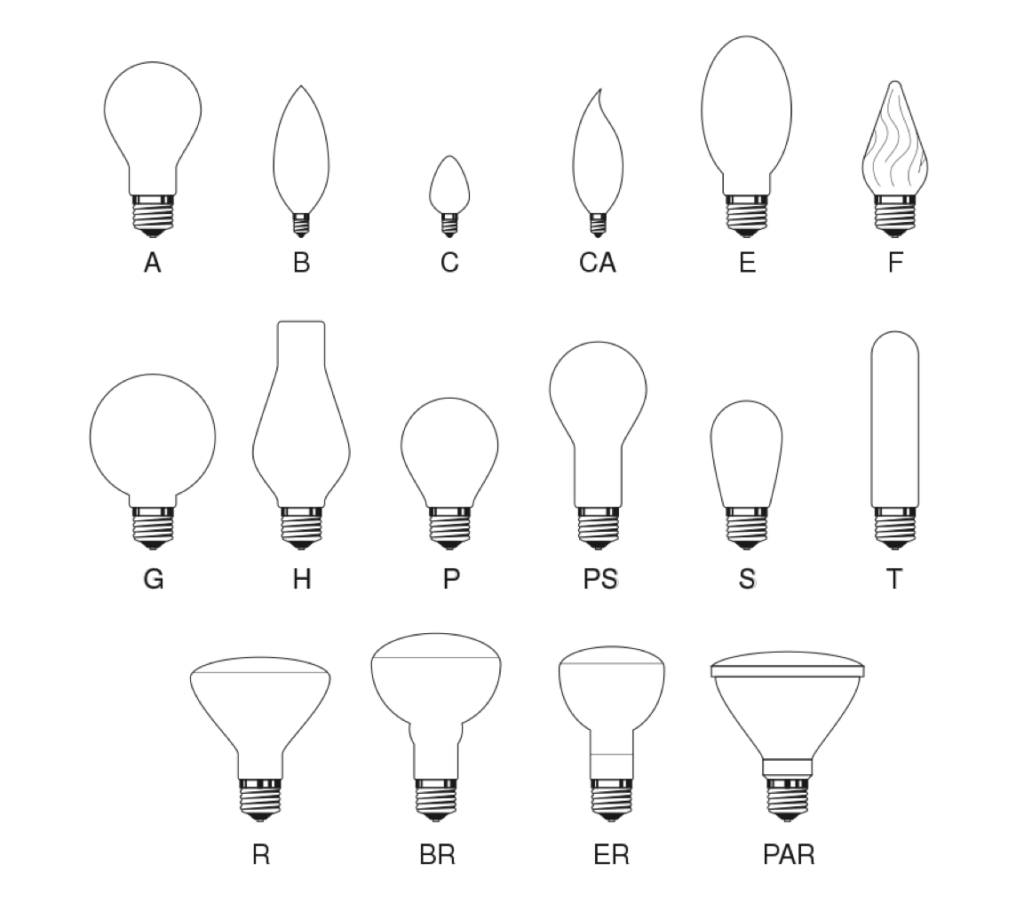
The most popular flask markings and their interpretation:
- A - traditional pear shape (similar to incandescent lamps);
- C - the shape of the candle;
- R - resembles a mushroom;
- G - spherical flask;
- T - tubular structure;
- P - spherical shape.
A base is used to connect the device to the lighting system. The most popular are traditional plinths marked "E". They are provided with a threaded connection to the cartridge.
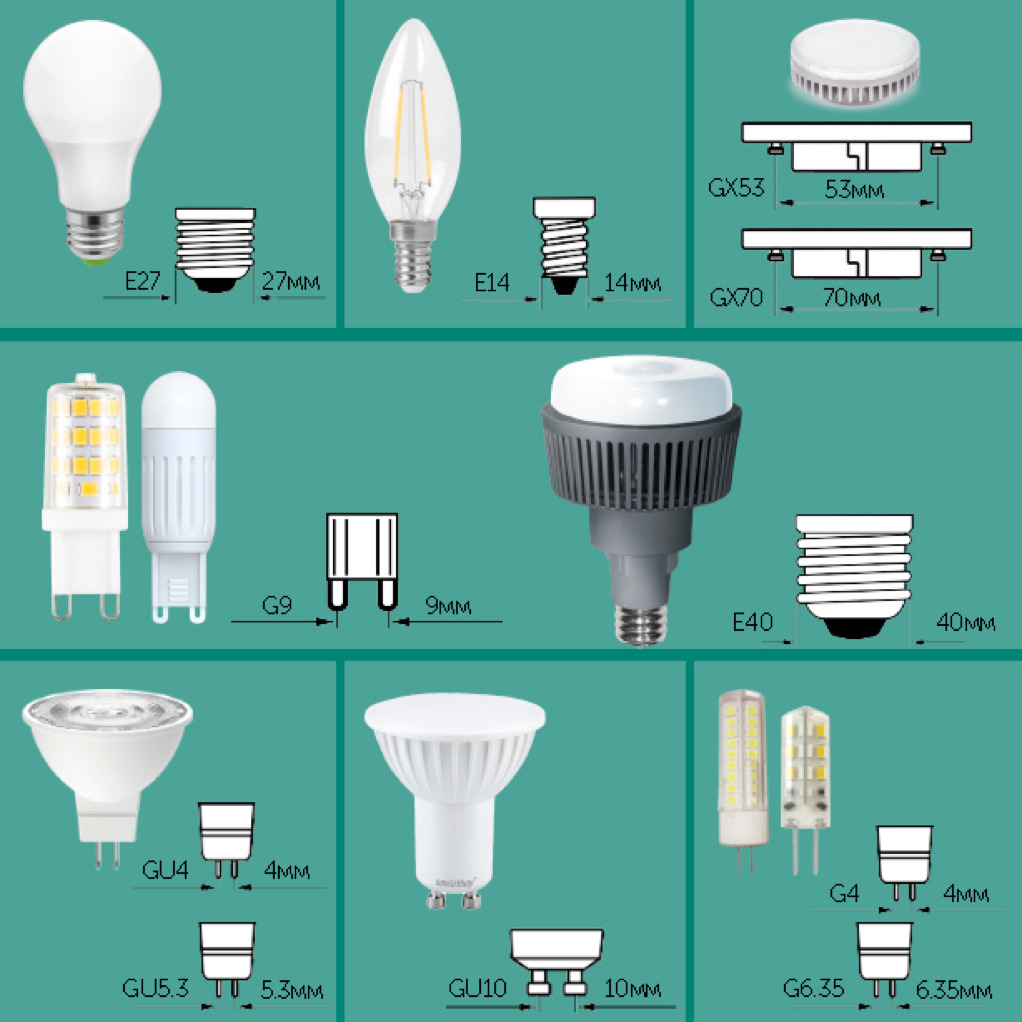
Next to the letter is a number that determines the diameter of the thread. Many devices have a base with the abbreviation E27. They are suitable for replacing traditional incandescent lamps. Slightly less common are models with the abbreviation E14, suggesting a reduced thread diameter.
In street lamps, you can often find devices with a base of increased diameter E40. The flask itself in this case also increases significantly.
Markings "G" and "U" can be deciphered as a pin connection with a cartridge. The number following the letter indicates the distance between the two pins. Such models are most often found in ceiling lamps.
As an alternative to halogen lamps, LED devices with the designation "GU5.3" are used. They fit perfectly into the spot lighting system.
Often rooms are equipped with LED lamps as additional lighting. In this case, overhead devices with a socle of the GX53 type are used.
Network settings
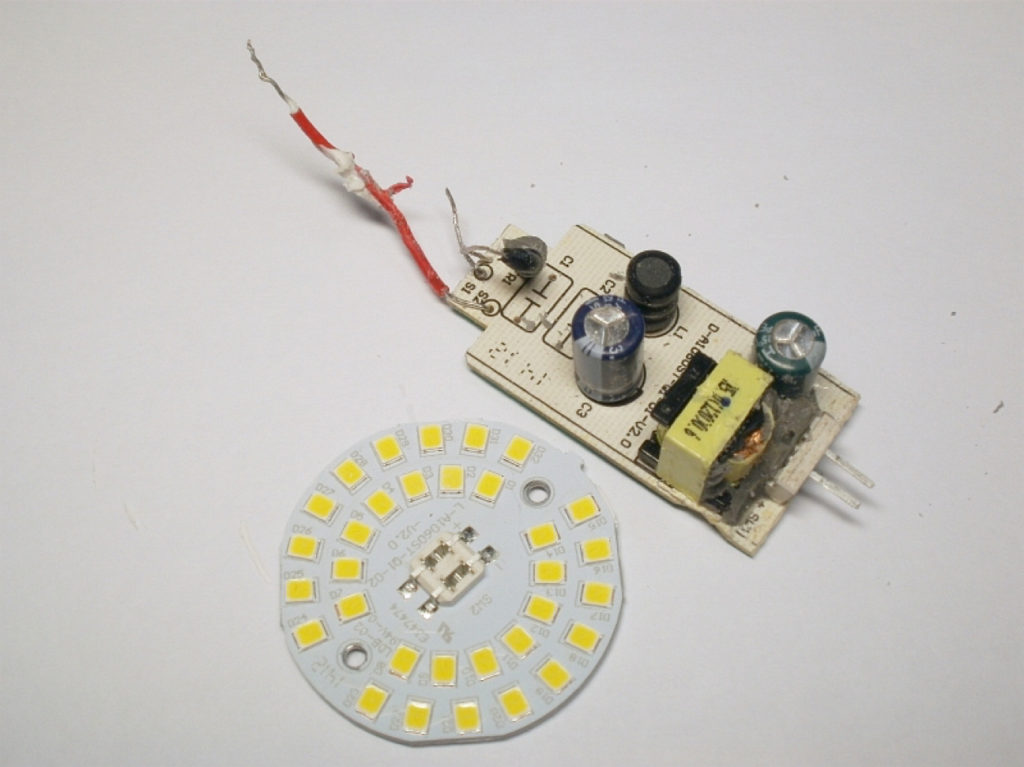
All LEDs function only when DC is applied. A conventional network in a socket assumes alternating current with a high voltage rating. Therefore, one of the main components of any lighting device is the driver. This power supply is based on PWM modulation and boasts high reliability.
Most modern light bulbs are equipped with a built-in driver installed in the inside of the radiator. This component rectifies alternating current and limits the voltage. The driver can only work with the device in which it is installed. It is not designed for additional load from the outside.
There are also remote drivers used on specific light sources and LED strips. In particular, when organizing RGB backlighting, sophisticated driver circuits are used that can supply their own voltage value to each crystal. Without such a function, it is impossible to form a multi-color backlight.
Colorful temperature
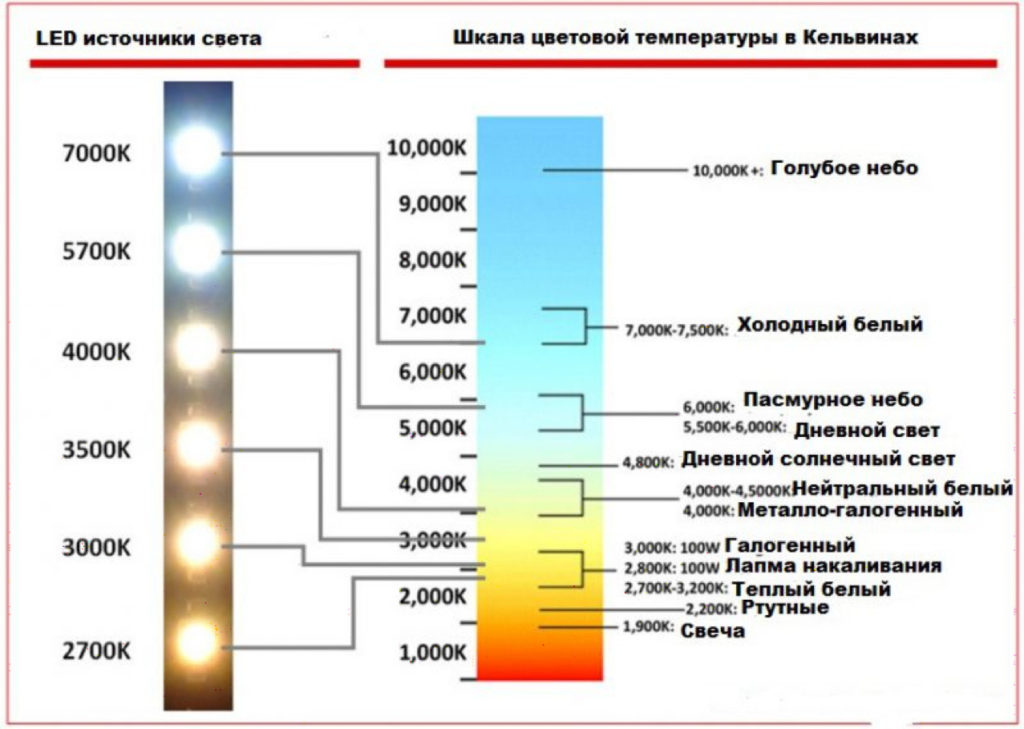
Traditional incandescent lamps have one color: yellow. In LED models, it becomes possible to adjust the color temperature, reaching both yellow shades and an almost white glow.
When building a color rendering scale, the color of hot metal is taken as the basis. Indicators are measured in kelvins. Standard daylight is measured at temperatures up to 6,000 degrees Kelvin, and hot metal at temperatures up to 2,700 degrees Kelvin.
All light above 6,500 degrees Kelvin can be safely attributed to cold bluish hues. When choosing a lamp for the home, it is advisable to take into account the color temperature indicators, since a different glow can lead to a different display of individual things or the interior as a whole. In addition, an incorrectly selected shade sometimes causes increased eye fatigue.
On the boxes, manufacturers always try to indicate a specific color temperature, as well as give a spectrum for a better understanding of the parameter.
Life time
Brands that manufacture LED devices indicate on the packaging how many hours the diodes installed in the design can work. This indicator is extremely approximate, since in addition to diodes, other nodes can also fail. As a result, the service life will depend on the quality of the components used, the correct soldering and operating conditions.
Power
The most obvious parameter by which users often choose a lighting fixture. Means energy consumption per hour and is expressed in watts (W, W). The characteristic is most often written on the box in large numbers, and next to it is the equivalent value of the incandescent lamp.
For the home, it is advisable to choose appliances with a power of 3 to 20 watts. Outdoors, they will be effective at about 25 watts.
When replacing standard incandescent lamps with LED-devices, it is necessary to use tables that draw an analogy in terms of power and efficiency between products of different types.
Light output
Luminous efficiency determines the relationship between the luminous flux and the power of the lighting device.The indicator is determined in Lm / W and accurately reflects the efficiency of a particular LED lamp. According to this parameter, LEDs are often compared with incandescent lamps that have gone into the past, confirming the usefulness of using the former. On average, the luminous efficacy of LED fixtures is 10 times greater than that of incandescent lamps with the same flux.
It is advisable to purchase only high-quality models from well-known manufacturers, since Chinese counterparts in reality may not be as effective.
Scattering angle
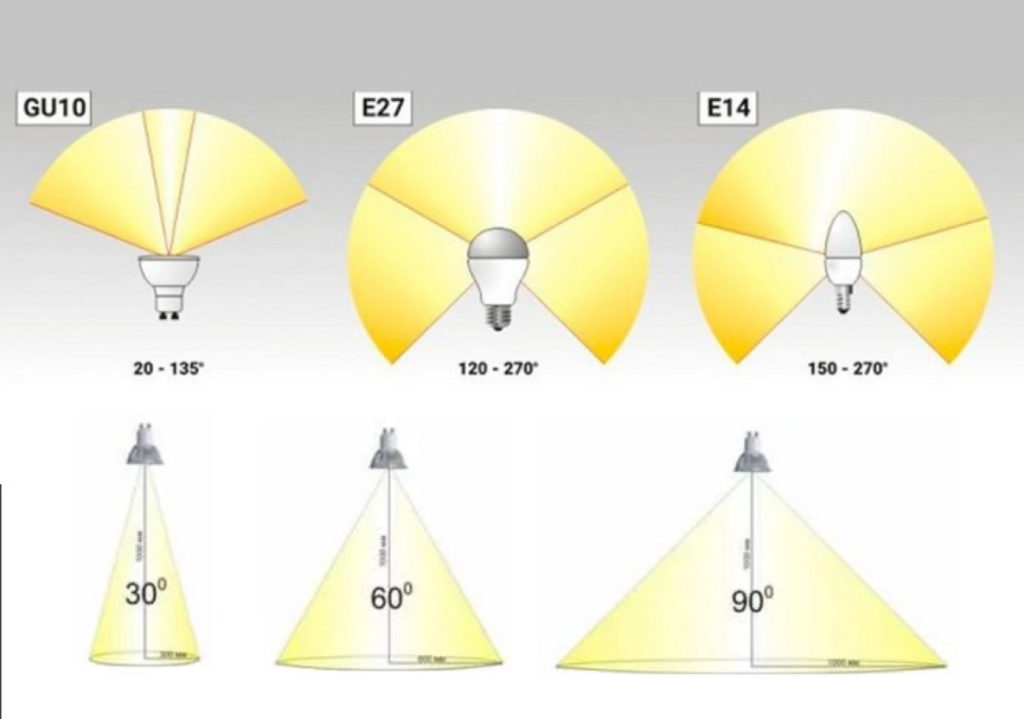
Any LEDs have specific directional properties. Special diffusers can be installed to distribute light into the luminaires. You can also adjust the direction by fixing the LEDs at different angles.
In modern lighting fixtures, the beam angle is usually 30, 60, 90, or 120 degrees. The most advanced models boast a dispersion angle of 210 degrees.
fire hazard
All LED fixtures are much safer than incandescent bulbs. Even with very long operation, these devices only heat up to 50 degrees Celsius, which prevents their destruction, and also does not allow you to get badly burned.
Low heating temperatures during operation allow the devices to be used in rooms with combustible materials. At the same time, manufacturers usually do not indicate the level of fire hazard on the packages.
Degree of protection against dust and moisture
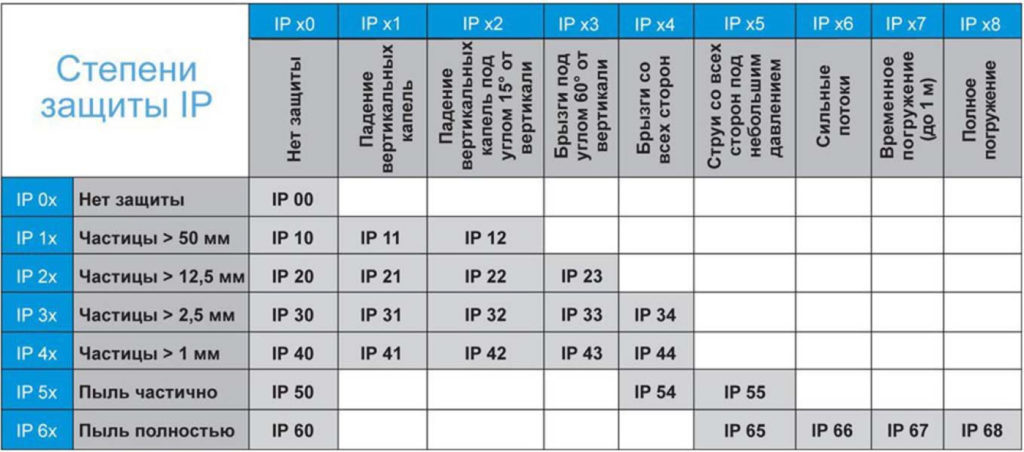
The level of protection of the lamp from dust and moisture directly depends on where exactly it is planned to use the lighting device. For street lamps, the indicators are the same, but for apartment lamps they are completely different.As a designation of protection, marking of the form IPXX is used, where XX is a specific indicator of security.
Electronic countermeasures (REP)
A large number of LED lamps during operation create a flickering effect that adversely affects vision and reduces the comfort of being in the room. In order to get rid of or smooth out this effect, add-ons are used that make up the electronic countermeasures system (REW).
When buying lamps, the ripple factor deserves attention. The lower this parameter, the more uniform the glow will be.
Flickering is commonly referred to as high-frequency flashes created by a lighting device during operation. Visually, such pulsations are practically not detected, but the brain is actually able to respond to blinks with a frequency of up to 300 Hz.
- The abbreviation REP on LED lamps usually means the ability of a particular device to prevent pulsations that occur and smooth them to a minimum. Also, the parameter is often called the ripple coefficient and is expressed as a percentage.
- Recently, pulsation indicators have begun to be normalized and controlled using sanitary standards. For this reason, lighting inspections are carried out regularly in many public places.
- Manufacturers rarely indicate the ripple factor on their light bulbs. However, on high-quality devices you can find the designation "no pulsation".
We advise you to watch the video: What to consider when choosing LED lamps.
You can determine the ripple of a particular lamp using an oscilloscope. In this case, the values of the oscillation amplitude and the voltage of the power supply are recorded. The amplitude is then divided by the voltage to obtain the ripple factor.