How to properly adjust PTF
PTF adjustment is an important process that should be approached responsibly. Not only comfort depends on the fog lights, but also the safety of movement in bad weather conditions. It is important to know how the adjustment process is carried out correctly, how to perform it, and what mistakes to avoid.
Requirements for adjusting the PTF
In the case of foglights, the installation “for show” will not work. This is a very important lighting unit, the parameters of which are strictly determined by the rules of traffic rules, GOST, UNECE. According to the documents, the following main requirements are put forward:
- PTF should be at a height of at least 25 centimeters from the ground.
- The distance from the PTF to the outer dimension of the machine is a maximum of 40 centimeters.

The norms concern not only the location of lighting devices, but also the characteristics of the light itself:
- The beam should go downwards. The upper limit of the light flux is clear.
- The horizontal dispersion angle should not exceed 70 degrees.
The requirements are written at the official level, so their violation will not only lead to a deterioration in the comfort and safety of movement, but will also entail liability in accordance with the law.
The documents also indicate the conditions for the use of foglights. It makes no sense to turn them on with good visibility, but during worsening weather conditions (fog, rain, snow) they will become useful. Also PTF is allowed to be used on difficult road sections: serpentines, sharp turns, etc.

Therefore, it is necessary to adjust the car fog lamps to meet both the installation site requirement and the light beam requirements. Usually PTF is installed at a height of 30-70 cm from the ground, the light from them is directed to the road.
Instructions for the correct setting
You can properly adjust the PTF yourself. In the process, it is important not so much to strictly adhere to the instructions, but also the preparatory work that concerns the headlights themselves, the car, and the site where the adjustment will be carried out. If it is not possible to carry out the adjustment, it is better to contact the service station, where they will cope with the task quickly and efficiently. If you want to do everything yourself, then you should read the instructions in detail.
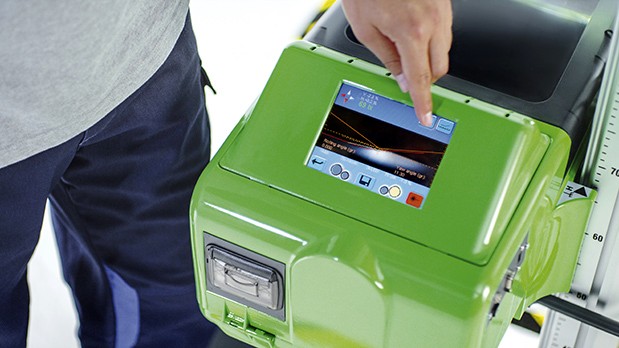
Preparation of cars, headlights, platforms, materials
The accuracy of the adjustment result depends on the preparatory stage. Even if everything is done correctly, but the preparation requirements are not met, the fog lights will not meet the standards.
So, in order to set up the PTF correctly, you need:
- Prepare site. It is important that it is horizontal.You can check this approximately by eye or use the building level. Ideal evenness as at a construction site is not required, but horizontality must be observed.
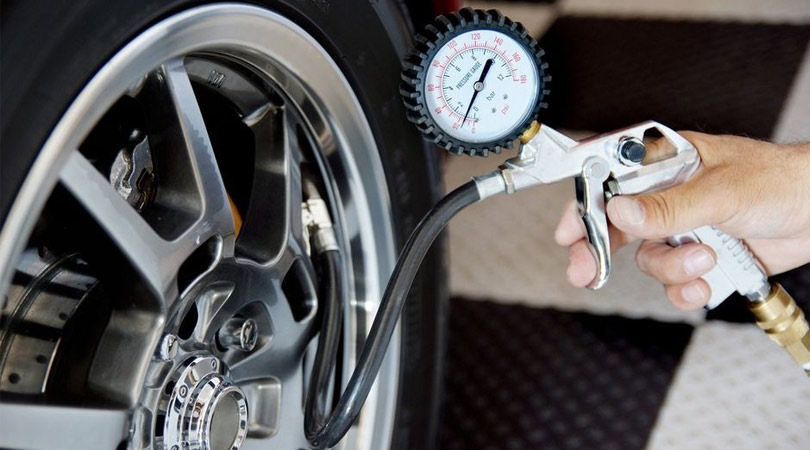
- Tire pressure check, pumping up all four wheels to the standard level. This is important, because if the pressure during the installation of the PTF is incorrect, then after the future tire inflation, the characteristics of the headlights will change.
![How to properly adjust PTF]() Pressure testing is a must.
Pressure testing is a must. - Refuel the car. Before adjusting, you need to fill the fuel tank.
- Load car. In the cabin and trunk should be the workload, which in most cases is standard for a particular vehicle.
- Screen installation. The special screen must be placed in a vertical position 10 meters from the machine.
- Markup preparation. It can be applied to a wall or garage door.
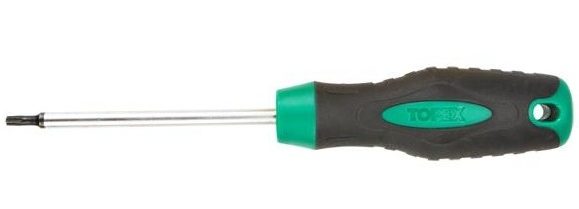
- Instrument preparation. In the work you will need screwdrivers, measuring tools (tape measure, ruler), marker or chalk.
![How to properly adjust PTF]() A screwdriver is a tool used to make adjustments.
A screwdriver is a tool used to make adjustments. - headlight cleaning. It is important that there are no dust, dirt, stickers on the ceiling lamps so that the light comes out in full.
When all the requirements are met, you can proceed to the main part of the process - adjusting the PTF.

Adjustment guide
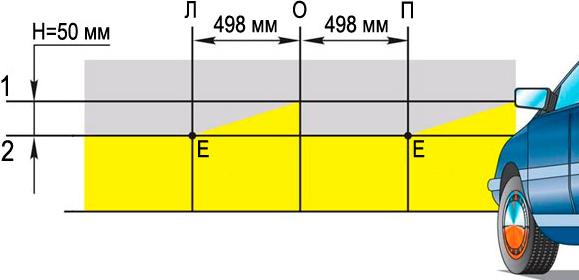
First you need to take a marking tool (chalk or a marker will do) and a retractable tape measure. Marking will be the first step in the work, it is important to do it correctly on the wall or previously prepared screen.
Start applying markup with the following elements:
- a vertical strip that corresponds to the central axis of the vehicle;
- two parallel stripes that run in the center of the foglights;
- a horizontal upper strip, which will become a level between the center of the PTF and the surface of the roadway;
- horizontal line, which depends on the location of the top line and the distance from the car. So, if there are 10 meters from the screen to the markings, and the height of the upper strip is 25-50 centimeters, then the bottom line will be 10 cm. When adjusted with a distance of 5 meters, this figure will be 5 cm.
After marking, you can turn on the fog lights and determine if they are correctly configured. To do this, one cover must be closed with a dense material that will not let light through (cardboard will do).
If the light is set incorrectly, you need to start adjusting. For this, special adjusting screws are provided in the design of vehicles. Their location may vary depending on the specific vehicle model, the easiest way to find out exactly where the screws are is from the instructions. You need to twist these elements until you can configure the PTF so that:
- the center of the bright spot from the light coincided with the points of intersection of the vertical parallel stripes with the lower horizontal line;
- the top line of light should be exactly on the bottom horizontal bar.
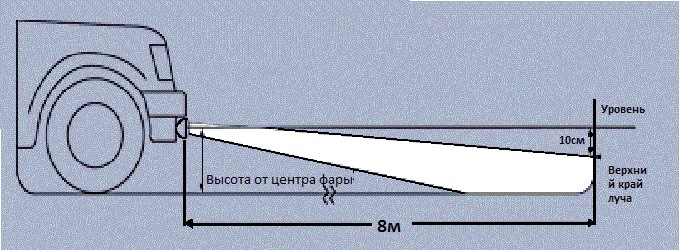
It is also important that the light has a uniform directionality from both the left fog lamp and the right one. If such a result was achieved, the adjustment process can be considered successfully completed.
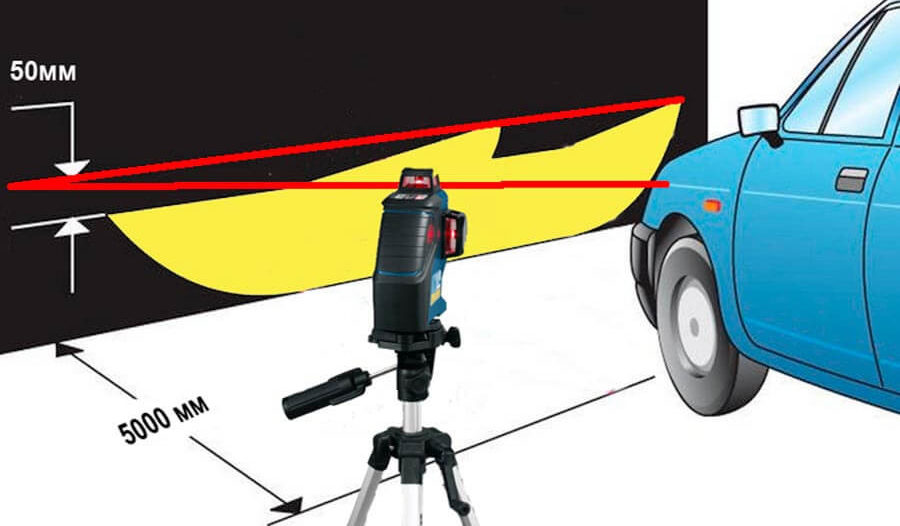
Alternative way. Instead of a regular measuring tape, you can use a more modern tool - a laser level.It also lines up so that the line divides the fog lamp cover in half.
We recommend watching the setup tutorial.
Common adjustment errors
You can really set up the PTF on your own and save money that would be spent on this service in the service station. But self-adjustment often does not bring the desired result due to mistakes:
- Work is done by eye. Of course, you can visually roughly determine whether the fog lights are well tuned, but this does not always work out. It is necessary to check the directivity of the light only with markings.
- The technical condition of the car. The car can skew if the suspension springs are faulty. Therefore, these nodes must be checked before work is carried out.
- Replacement of lamps in PTF. When substituting, people often choose xenon instead of standard bulbs, as a result, visibility on the road in bad weather is unsatisfactory. The fact is that it is yellow light that effectively penetrates fog and precipitation.
![How to properly adjust PTF]() Xenon looks nice but is less effective in bad weather.
Xenon looks nice but is less effective in bad weather. - Neglect of the preparatory stage. If the surface is not level or the pressure in the wheels is not the same, then the light output will be distorted.
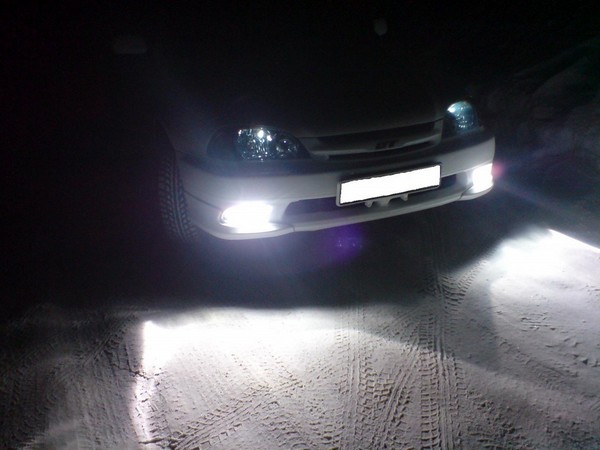
If everything is done according to the instructions, no errors should occur, it will turn out to correctly adjust the fog lights. This will take no more than 30 minutes.