LED lamp circuit
Every year the demand for LED bulbs is growing. They may soon replace incandescent and fluorescent lamps, which are not as safe, last as long, absorb more electricity, and cannot be repaired if they break.
The circuit of the LED light bulb is simple for both an experienced electrician and a beginner. But the device of LED-lamps is more complicated than fluorescent ones. If you need to replace the LED, you need not only to understand the light bulb circuit, but also be able to use a soldering iron, as well as understand the principle of operation of the elements.
Varieties of schemes
The driver is needed to stabilize the voltage and is assembled using circuits on capacitors and transformers. The second option is more economical, and the first is necessary to create a powerful lamp. In addition, there is another type of circuit - inverter. They are used in the production of dimmable lamps and a large number of chips.
Pulse drivers
Compared with the linear driver, which uses a capacitor, the pulse one has an effective protection against instability in the network.To see in detail an example of a diode lamp switching circuit, we use the model CPC9909. The efficiency of this product reaches 98%, so without exaggeration it can be considered one of the most economical and energy-saving.
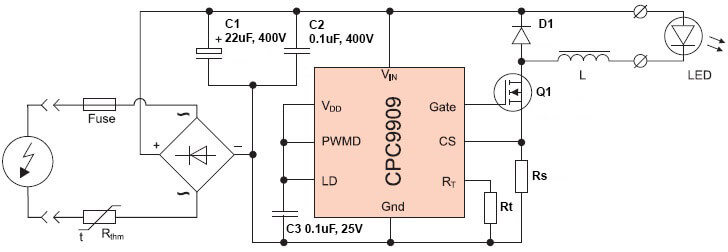
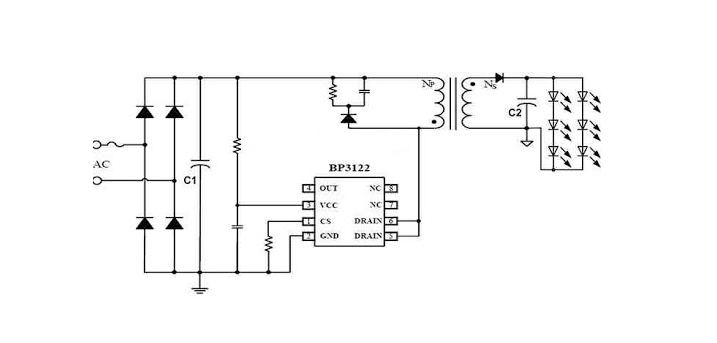
The device can be connected to high voltage (550 V) thanks to the built-in driver with a stabilizer. This simplified the circuit and reduced the cost of the device.
A switching driver connection is used to activate lighting in the event of an accident, and would be an example of boost converters. At home, based on the CPC9909 driver model, you can assemble a lamp that will be powered by batteries or a driver, but the power will not exceed 25 V.
Dimmable Drivers
With the help of a dimmable driver, the brightness of the LED lamp can be adjusted, which will allow you to set the required level of lighting in each of the rooms, reduce the brightness of the light during the day. Devices are used to emphasize some interior items.
The dimmer saves energy, since it is not necessary to turn on the lamp at full power every time it is turned on, which has a positive effect on the service life of the product.
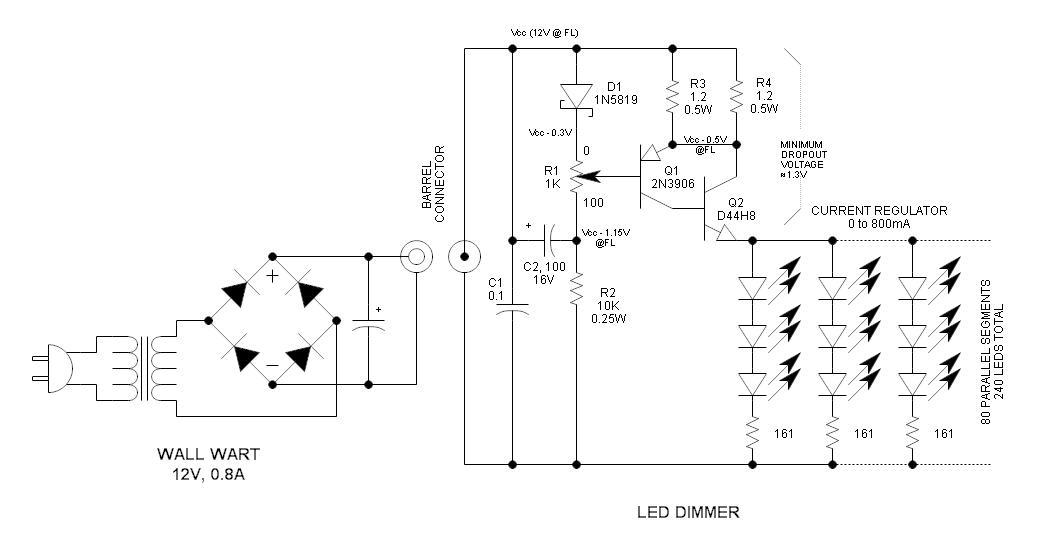
In production, two types of dimmable drivers are used. Each has pros and cons. Some work on pulse-width modulation (PWM). The dimmer is installed between the diodes and the power supply. The circuit is powered by pulses of different durations. A good example of PWM control is a running line.
The second variety of dimmable drivers affects the power supply. They are widely used for products with the ability to stabilize the current. The adjustment may affect the hue of the lighting.If these are white chips, when the current decreases, they will glow yellow, and when the current increases, they will glow blue.
Capacitor
The capacitor circuit can be considered one of the best-selling circuits, it is often found in household fixtures.
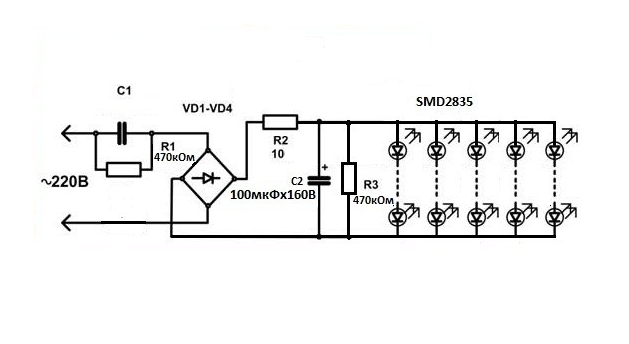
Capacitor C1 is needed to protect the device from network interference. C4 will smooth out the ripples. When current is applied, resistors R3-R2 will limit it and protect the circuit from a short circuit. Element VD1 converts alternating voltage. When the current supply stops, the capacitor will discharge through the resistor R4. But the R2-R3 elements are not used by all manufacturers of LED lamps.
To check the performance of the capacitor, a multimeter is used. The scheme has several disadvantages:
- it will not be possible to achieve a high brightness of the glow, more capacious capacitors will be needed;
- there is a risk of overheating of the chips due to the instability of the current supply;
- no galvanic isolation, possible electric shock. When disassembling the light bulb, do not touch the current-carrying elements with bare hands.
Despite the disadvantages, the scheme has many advantages, the lamps sell well. This is ease of assembly, low prices and the breadth of the output voltage range. Even masters with modest experience can try to make a product on their own. To do this, some parts can be removed from old TVs or receivers.
Recommended for viewing: A simple LED lamp power supply circuit
LED voltage in lamps
The voltage of the LEDs in the lamp is in the range from 110 to 220 volts. These indicators are achieved by combining several chips. Reducing voltage and direct current is the work of a driver that is in every lamp.
If it is not there, and the light bulb needs to be started from the network, you will need to connect an external device. Not so long ago, LEDs operating on alternating voltage appeared. But since they pass current in only one direction, they remained in the niche of products operating on direct current.
